Friday, July 25, 2014

Fitness, Practice, and Social Change

A central component of any change process – personal change or organizational change – is the concept of practice.
— Ng’ethe Maina and Staci Haines, The Transformative Power of Practice

I've been thinking a lot about practice recently. My current practice is pretty good: on weekdays, I get up, exercise almost every day, work at a job that is fulfilling and that I generally enjoy, eat good and reasonably healthy food, drink good beer, go to bed. I generally take enough down time on the weekends to recharge and keep in house in order, and I spend enough time with my spouse and kids to maintain good relationships with them. Over the years I've learned how to respond to most difficult situations with patience, humility and compassion instead of anger, frustration and insecurity. In Maina and Haines's terminology, I've been intentional enough about changing my practice that my default practice now aligns pretty well with my "present-day values, politics, [and what I] care most about" (I should also note that I have been lucky/privileged enough not to have experienced the kind of trauma that can lead people, for reasons of immediate survival, to develop practices that in the long run are not healthy/aligned with their values/etc.)

Still, there are things that I would like to do more of: writing (beyond what I do at my job), composing and playing music, and being more involved in local political work. To some degree, these are limited by the number of hours in the day, but I recognize that if I want to find the time to spend even a few hours more on these activities, I need to change my daily practice.

I've also been thinking about practice a lot because I recently, largely by accident, became part of a fascinating and compelling online community of people who attended one of the institutions of higher education that made up my somewhat checkered higher-ed career. Over the past six months, this community — originally devoted almost entirely to witty banter mocking the seriousness of official alumni publications — has become equal parts comedy improv troupe, free-ranging discussion forum, and on-demand support group for any number of issues, with a good dash of exhibitionism, flirtatiousness and hedonism ("drink threads" are de rigeur on weekends, and common during the week) thrown in.

One of the things that I find especially fascinating about this community is how people have started using it as a sort of accountability mechanism to change their practice. As in, literally, people will post about something that they intend to do (but might be worried they won't actually follow through on), in order to be "held accountable" by the group.

This is most noticable in a spinoff group devoted to fitness. And, even without having had a conscious desire to improve my own fitness practice, I have noticed that the ritual of posting my daily workout to the fitness group, reading other's workouts (at all levels — from starting to get off the couch to qualifying for national triathalons), and us all encouraging each other with comments and "likes," has increased the length of my runs, the intensity of my gym workouts, and my curiousity about other forms of exercise (I've even flirted with the idea of re-learning how to swim).

The world of fitness, of course, as both a social phenomenon and a capitalist industry, has done an exceptional job figuring out how to create this kind of culture of accountability and encouragement. The kind of camraderie formed at races, in zumba and spin and yoga classes, etc., is crucial to the industry's profitability and growth — and this has naturally spread to social media.

Now, I have fitness goals (it would be great to lose the noticable beer belly I've had for the last 5 years or so), but I've got other goals as well, as mentioned above. Many of these not-fitness goals, especially writing about politics and culture, are essentially social (I want to change society), even if the mechanism (writing) is a solitary activity. So I find it kind of ironic that I am currently, in essence, pursuing my personal goals in a social manner, while I think of the work to pursue my social goals as something that I just need to "find more time for" in my personal life. (To be fair, this is probably exacerbated by the fact that my spouse are both doing essentially social and political work at our jobs for 8-10 hours per day; it's just the "extracurricular" social goals, as it were, the ones I don't get paid for, that I'm talking about here).

I don't think this is totally uncommon. We know (from opinion polls, surveys, our own door-to-door work) that people want the world to be a better place. Yet even our most popular actions are dwarfed by the number of people who turn out for 5Ks every weekend. Our job, as a movement, is to help more people — if we want to succeed, millions of people — feel supported and accountable in being part of changing the world, in ways that are effective and also doable. To grow to scale, we can't just "organize" people as we currently understand it — getting them to participate in social-change organizations through repeated reminders and turn-out calls and so forth, and if we're lucky recruiting a few more volunteers to help us with the turn-out calls — we need to bring people to a place where "showing up" for justice (in whatever way) becomes part of their default practice.

I think part of the appeal of the fitness world is precisely the kind of casual camraderie of racing or taking a class together, or being part of an online fitness community. It is precisely that kind of community that capitalism has hollowed out, especially in recent decades as the massive disruption of globalization has forced people to move and the casualization of work has made it difficult to even maintain regular social practice within families, let alone the (generally) less intense social interactions of friendships, reading groups, bowling leagues, etc.

In this environment, most of us struggle to maintain two really intense relationships: one with our job (or jobs), and another with our partner and/or immediate family (or spending energy trying to find or establish one). These relationships, even when not fraught with oppressive power dynamics, are extremely high-stakes, and thus I think are actually particularly ill-suited places to think about changing our practice. In these intense and high-stakes 1:1 relationships which structure the vast majority of our waking hours, we dig more deeply into our default practices, and we're also less likely to hold the other person/institution accountable, even in the smallest of ways.

And, the problem with so much movement organizing is that we expect people's relationships to our organizations to mirror the same kind of intense relationships we have with our employers (especially if we, ourselves, are professional organizers or staff of social-justice organizations) and our families. Perhaps not consciously, but subconsciously — we always talk about wanting to provide "easy asks," low-intensity ways for people to participate (such as signing petitions), but at some level we're just scanning the petition signers for potential "leaders," people who could be brought to having the same intense commitment to the organization as we do. We rarely think seriously about how people could particpate in and be accountable to the organization in the way that they are part of and accountable to their spin class.

So, I have a couple of questions I think we should be thinking about (and I welcome thoughts in the comments):

First, how do we (not just people who currently identify as movement organizers, but anyone who wants to see a better world), provide ourselves and others with a structure that allows us to pursue our social-change goals with a similar flexibility, accountability and scalability as, say, the world of running (while recognizing that it's much harder to do something when it's (a) not generating profit and (b) actually threatening people with power).

Second, since I sort of work in the intersection of technology and social change, are there existing platforms, apps, etc. that include similar social-accountability mechanisms as the fitness-based ones yet are flexible enough to be used for social-change goals? Is there something already developed for social-change purposes that organizations could use and experiment with? If not, is there a need for one?

Tuesday, July 08, 2014

Big Water

In which my healthy respect for the destructive power of water is reinforced through a terrifying personal experience.


Yesterday, I went white-water rafting for the first, and probably last, time. It's not likely something I would have agreed to do, but my dear spouse bid on, and won, four tickets in a silent auction to support Voices for Vermont's Children. So, off to the Maine wilderness we went.

I grew up in Kansas, and while there were a couple of lakes around, I never really had occasion to go out on them in boats of any kind. Boats make me nervous, even large stable ones in calm water. I just like having my feet connected solidly to the earth (I dislike flying, never learned how to ride a bike, and prefer not to drive whenever I can avoid it, for the same reason).

But, of course, what really freaked me out, when I thought about it (which I tried not to do), was the idea of one of the kids going overboard, and not being able to help them. That "do I dive into dangerous waters when I don't know what I'm doing and can barely swim but I'm counting on the superhuman strength parents are supposed to get from adrenaline when their kid's in danger" moment played over in my mind more than a few times.

The safety lecture at the beginning of the trip was somewhat reassuring; we all had lifejackets (or "personal floatation devices" as they are apparently now called), fitted by the guides. They reassured us that the river was deep, that the guides were professional, that even if we had an "out of boat experience" we would be fine, that no one had drowned in forever, etc. And, of course, this is a major industry up here, which it couldn't be if the change of harm weren't extremely low. But still, there were the waivers, and yesterday was "big water" - over 8,000 cubic feet per second rushing down the river.

* * *

I developed a healthy respect for the destructive power of water three years ago, when Vermont experienced not one but three major flooding events. First, in the spring, the increasingly erratic climate (thanks, Big Oil!) followed a winter of heavy snowfall with a week of eighty-degree temperatures in March. I was working at the time in Winooski, a former mill town that shares the Winooski River with Burlington. Crossing the bridge every morning, I saw — and heard — the runoff-swollen river pouring over the top of the dam with so much force that you couldn't really see the dam, just the water crashing against the concrete walls on either side and then turning and cascading down like a sloping hill into what is normally the tranquil eddies of Salmon Hole fishing area, below the dam.

All that water raised Lake Champlain to record highs; low-lying homes and businesses were flooded. Parts of the waterfront park and all of the lakeside beaches were underwater until July, and the water eroded the soil under the lakefront bikepath in numerous places, causing it to collapse and requiring a couple of million dollars worth of repairs over the last few years.

In the middle of the summer, there was flooding in central Vermont, flooding which unearthed enough storage tanks from gas stations and so forth to make all the traditional swimming holes unusable.

And then, of course, came Irene at the end of the summer. Although it was downgraded from "Hurricane" to "Tropical Storm" by the time it hit Vermont (because the wind speeds had reduced, presumably), the torrential rain dumped into the narrow mountain valleys carried a shocking destructive power. The sudden swelling of rivers and creeks took out bridges, destroyed homes, and killed at least one person.

Irene really brought home the realities of climate change for me, and I think for most people in Vermont. In addition to the sheer destructive power, it also made me realize how fragile our technology-reliant society is. With bridges and roads washed out, whole towns were cut off from food and other necessities, which had to be airlifted in. An industrial food system depends on trucks, which depend on paved roads and bridges. Which continue to exist only at the pleasure of the rivers.

* * *

Editor's note: this is the part of the blog post where, if it were a New Yorker article written by a professional writer with a budget, there would be a fascinating and well-researched detour over into economic and social history. Since it's just me tapping away on my computer in the morning before everyone else gets up, in a lodge with no internet access, it will instead be a brief bit of hearsay and speculation.

While we were milling around getting our gear and waiting for the safety speech, I overheard a young woman asking one of the guides how many people died while rafting. He gave the standard answer: "A lot fewer than have died logging."

The Kennebec river (like many others in New England, upstate New York, and I suspect anywhere with rivers and forests) had long been used for transporting logs. Loggers would lash the fallen trees together into rafts and ride them down the river — when safety gear consisted of leather boots and wool clothing.

In the 1950s, a modern hydroelectric dam was built on the Kennebec. One of its features was a sluice for running logs down.

The guide on our raft told us that in 1976, the night that logging on the river was finally shut down, one enterprising guy rounded up a bunch of soon-to-be-unemployed loggers in a bar, paid them each a thousand dollars to go down the rapids in a raft, and thus was born the modern rafting industry. The rafting company founded by that guy now runs a resort with a hot tub, a brew pub, and all the amenities (we stopped there for dinner the night before our trip).

We're a bit further up Route 201, where I'm writing this on the front porch of a much more primitive lodge, watching truck after truck go by, trailers piled high with logs.

* * *

We lowered the raft into the water just below the dam. The rafting industry depends on controlled releases of water from the dam, which happens at 10 o'clock every morning. The dam operators tell the rafters the amount of water they are going to release, so they can plan for conditions on the river. Yesterday was 8,000 cubic feet per second — "Big Water."

When you go white-water rafting, you're not strapped into the raft at all — in fact, you're not really "in" the raft, you're sitting on the very edge, with paddles. The secret, apparently, is to have enough momentum going into the big waves to, well, stay upright, and you create that momentum by padding furiously along with your raft-mates, under the direction of your guide.

I've been flying a lot recently, and have had some success in dealing with my nervousness during takeoff, landing, and turbulence by trying to mentally lean in to the motion of the plane, not expecting it to be some luxurious space for relaxation that just happens to get you to another city (as, say, airline commercial portray it), but more of a wild ride, a dangerous but thrilling trip with some arrogant mythical beasts who believe they have conquered the air.

I found, surprisingly, that I was able to do that we started going through the Class 1 rapids. I realized I had been preparing myself in the wrong way, thinking about this as a trip in a vehicle, and obsessing about whether the vehicle was safe, what would happen if I or one of my family fell out of the vehicle. I was worried about whether the vehicle would protect us from the river. Instead, as we careened through waves, I realized that we were just out on the river, ourselves, with a few tools — the raft, the life jackets, the paddles, the helmets — that would hopefully keep the river from damaging us. Remarkably, I passed through my fears and started enjoying myself.

Which was damn good, because when we hit the Class 4 wave — "Maytag" — the wave, as they say, tagged us. It is a 16-foot wave, about the length of our raft, and there was a sudden moment when I realized we were flipping over.


And then I was in the water. They say that in times of crisis, time seems to go slowly. I am incredibly thankful that, at least in memory, those few seconds seemed to only last a few seconds.

I was completely submerged in water, no idea even which way was up, felt the bottom of the river with my feet (which is pretty deep there, so I must have been thrown straight down, and with a lot of force, when the raft flipped). The first phase: pure animal, physical terror.

Within a second or two, the lifejacket pulled me up and suddenly I was half-breathing, half-drinking, being buffeted around by the waves. They tell you, if you go into the water, you'll most likely come up near the raft — but this is less true when your raft is overturned by Maytag, apparently; I was a good ten feet from the raft. I started flailing towards it (you can't really call it swimming).  Some of the safety instructions, most of which were heavy on "self-rescue" techniques, started floating back into my brain.  While flailing towards the raft, I tried holding the paddle, which I still had a grip on, out towards it, in the vain hope that someone would grab it and pull me towards the raft.

They also tell you to keep your eyes open, anticipate the waves so that you can breathe when your head is above water and not when you're hitting a wave.  This is all very fine in theory, but I was now highly conscious of how utterly incapable I was of doing this. The second phase: the conscious realization of what you need to do to save yourself, and how you may not be able to do it.

Then I heard my wife (who, along with our son, had been hauled up onto the flipped-over raft at this point) yelling our daughter's name.  The third, and worst, phase: realizing that your child may be in danger, and that there is absolutely nothing you can do about it.

* * *

Our daughter was (I learned later) briefly trapped under the raft, but by the time I got to the raft had gotten herself out and been hauled up. Eventually (well, within a few seconds), I also got to the raft, grabbed on, tried to pull myself up onto it with no success, but got hauled up by the guide.

The river is relatively calm after Maytag, so we were able to regroup pretty easily; they loaded us onto one of the company's other rafts while the guide flipped our raft back over, then we got back onto it. The guide pulled some candy and knit hats out of the dry bag, and we floated uneventfully down the remaining eight miles or so to our disembarkation point.

Water.  Don't fuck with it.

Saturday, February 23, 2013

Grits with shrimp, lacinato kale and poached eggs

This was incredibly delicious, if a bit on the rich side. Looking forward to having the leftovers for breakfast sometime in the next few days.

  1. First, prep your kale — destem and all that good stuff, and slice into strips. Also, dice up a small amount of some kind of hard, savory cured meat (I used a VT Smoke & Cure Meat Stick, because that was what I had on hand, but any kind of pepperoni, tasso, etc. would be good. Or you could use shallots instead). Oh yeah, and peel your shrimps.
  2. Bring 4 cups of chicken stock + 1/4 cup of cream and 1/2 tsp salt to a boil
  3. Add in 1 cup of grits, stirring until it starts to thicken. Once the grits are thick, turn the heat way down and continue to stir occasionally while cooking everything else.
  4. Heat a bit of oil in a reasonably wide and deep sauté pan with a lid, and sauté your meat and/or shallots for a few minutes.
  5. Add the kale and cook, stirring, for a minute or two, uncovered, until the kale is nice and glossy-looking. Season with salt and pepper as you're doing so.
  6. Add a good splash of white wine, stock and/or water, cover the pan, and cook for about five minutes.
  7. Check to make sure there's still enough liquid in the pan to steam/poach your eggs and shrimp. If it's pretty dry, add a bit more liquid. Crack your eggs over the greens on one side of the pan, then place the shrimp on the other side.
  8. Cover and cook for 2 minutes, until the egg whites are just cooked but still soft and the shrimp are just pink.
  9. Remove the shrimp from the pan with tongs. Spoon grits into bowls, use a slotted spoon to place the greens and eggs on top of the grits, top with shrimp and then sprinkle with a little additional salt and smoked paprika.

Chicken confit


This is pretty easy to make: just take some chicken thighs, legs or drumsticks, fit them snugly into a baking pan, scatter a bunch of sliced garlic and thyme over, then pour in enough extra-virgin olive oil to just cover the chicken. Bake at 300 degrees for about two hours (oil should be just bubbling). Strain the flavored oil off, and store in the refrigerator. To serve, crisp the chicken pieces up in a tablespoon or two of the oil.

Sunday, November 11, 2012

Practicing our scales

I think we need a deeper conversation about how organizers can think of our work as cultural work, and how (left) cultural workers can think of their work as organizing

The day after Obama was first elected, in 2008, I had a deep sinking feeling, and was incredibly depressed all day. Don't get me wrong — the night before I was caught up in all of the excitement of, among other things, a Democrat winning Virginia and North Carolina, and a sense that a small but significant victory had been won over white supremacy. But while Obama had always been pretty clear that he was a candidate of the center-right — he was just going to be smarter about pursuing imperialism abroad and austerity at home than Bush was — I could just see the widespread politicization and popular mobilization that characterized the last few years of the Bush administration dissolving into vagues "hopes" for "change." Having been a Reagan-era kid who was caught up in the excitement of Clinton's election in 1992 (as, I might add, the first president from the modern working class), I had seen this movie before.

This time around, I am cautiously optimistic that things will be better. The labor movement seems to understand the need to fight the austerity measures being proposed by both parties in the upcoming "fiscal cliff" negotiations, the remnants of Occupy (still organized enough to do a better job than FEMA in Hurricane Sandy relief) are not exactly lining up for cabinet positions, and the sector of the left that I identify with most strongly — the independent community- and worker-based organizations that make up such alliances as the National Domestic Workers Alliance, Grassroots Global Justice and Jobs with Justice — seem to be very clear on the need to both maintain independence from the Democratic party while building broad alliances.

However, none of this really matters if we can't, as it's often put, "organize to scale." Having been in and around conversations on this question as a staff person at NDWA, a leader and strategist at the Vermont Workers Center, and a pretty much lifelong member of the United Electrical Workers union, I thought now would be an opportune time to put down some of my thoughts on, um, paper.

* * *

1. Relevance

One line of thinking about "organizing to scale" looks at the organizations which have scale — trade unions, churches, Planned Parenthood, the National Rifle Association, etc. — and focuses on their relevance to people's day to day lives. Unions represent workers in their dealings with their bosses, churches provide a sense of community, address spiritual needs and increasingly act as the only social safety net around (as public programs are defunded), Planned Parenthood provides reproductive health services, the NRA gives people access to gun safety classes, shooting ranges, etc. The American Association of Retired Persons is, essentially, an insurance program. These organizations collectively have millions of members, and can still wield significant power in the electoral arena.

I think that in some sense, this analysis is spot-on. For a dozen years, I worked in a small shop with fairly high turnover. The likelihood that any of my co-workers would have ever gotten involved in any "movement" activities through their own social networks, or through being leafletted or door-knocked, is, I think, pretty small. The union gives us three things. First, it gives people an experience of collective action through the grievance and bargaining process. Second, it essentially forces people to take on leadership roles ("someone's gotta step up and be the steward, people"). Thirdly, and perhaps most importantly, it gives us a shared cultural context and identity which allows a college-educated dorky political guy in his 30s to engage younger hipsters and older working-class folks in political discussion and action.

But I think that, in a deeper sense, this analysis is deeply un-historical. Quite simply, trade unions, churches, Planned Parenthood and the NRA did not get to be the size that they are by behaving the way they currently behave. If that were the case, they'd still be growing, right? — something that is most emphatically not happening to the labor movement. We can rightly fault the particular weaknesses of the American labor movement, but the reality is that labor movements are in crisis throughout most of the world. *(but more on the recent growth of mega-churches below)

This is not to say that the existing mass organizations (trade unions especially) should not continue to try to organize, or that our smaller, more ideological and grassroots organizations shouldn't try to figure out ways to be more relevant to our members' (and potential members') day-to-day lives. We should just think carefully about how we're doing that — and we should be especially wary of strategies that rely on, essentially, modern mass-marketing techniques.

* * *

2. Participation

The labor movement couldn't have grown by offering workers collective bargaining and grievance handling — before collective bargaining was widely established (in the railroads in the late 19th/early 20th century, in mass industry in the 40s, in the public sector in the 70s, etc.), unions simply didn't have the power to "offer" representation to workers. While there are some unions that can organize this way in some industries today through card-check agreements, or political deals, anyone who has been through a knock-down drag-out organizing campaign — especially any successful one — knows that the one thing that is absolutely essential to organizing is a strong, representative organizing committee of committed leaders from inside the shop, who know and can move their co-workers.

I'm most familiar with the labor history of the CIO, which established collective bargaining in America's mass production industries in the 1930s and 1940s — and this pattern certainly holds. We frequently complain about how hard it is to organize workers under our "broken labor law" — and certainly the psychological sophistication of the multi-million-dollar union-busting industry is much greater now than it was then — but the reality is that workers in the 30s on the whole faced much more difficult conditions and "stuck with the union" for much longer, with much less in the way of "services," than we expect workers to do today. When my union, the UE, was founded in 1936, only one of the seventeen independent locals that gathered in Buffalo to form a new union in their industry had a contract. The United Auto Workers — founded a year earlier — didn't win a collective bargaining agreement with Ford until 1941, and only after suffering, among other things, direct violence at the hands of company goons.

What kept folks going? There's a variety of theories (and different unions had different organizational cultures), but crucial to the initial organizing of UE locals — much of which was initially underground, kept secret from the boss — was a structure of stewards organizing small groups of workers in each department. To this day, UE policy is that there should be a minimum of one steward for every ten workers, and some shops have even more.

These stewards were not people who "enforced the contract" — there was no contract initially — or navigated a bureaucratic grievance procedure. They were, fundamentally, rank and file workers who stepped up and took responsibility for leading a small group of their co-workers, in manageable tasks such as collecting dues and, frequently, organizing direct, collective confrontations with the foreman in the department. Numerous oral histories testify to the importance of these confrontations — of, in modern left-speak, people participating in their own collective liberation — in maintaining loyalty to the union.

These stewards networks in the UE and in the early UAW (and in many other industrial unions) not only kept the union alive when it had little to "offer" its members, they also created a culture of vibrant democracy within the unions and opportunities for women and workers of color to step up to leadership at a time when local officers were almost always white men. It was precisely the establishment of collective bargaining (and, it must be said, the eagerness of many union leaders to be incorporated into the power structures of the capitalist state) that, in most unions, turned the steward from a leader into a bureaucrat, and, in many unions like the UAW, eliminated their shop-floor power altogether.

* * *

3. (counter-)Culture

My wife grew up in the Church of Christ (not to be confused with the liberal United Church of Christ). She was never a liberal, she pretty much went directly from Republican-voting Christian to Marxist. We often talk about how for her, growing up in a culture that had a strong sense of values that countered the materialism of the dominant culture made it a lot easier for her to recognize the deep inhumanity of capitalism, once exposed to a Marxist critique of it. (To be transparent, the other members of her family are all over the map, politically).

Similarly, when I think about why the UE is so different from the rest of the American labor movement, and had such a transformative effect on me, there are plenty of structural reasons, sure — the ongoing commitment to a grassroots steward system, strict rules on preserving democracy within the union, frequent opportunities for local leaders to get together regionally — but I keep coming back to the culture of the organization. As just one example, UE meetings are officially run using Roberts Rule of Order, but they are far more participatory than many of the lefty "convergences" and "spokescouncils" and so forth I've been at that are run through consensus, with lots of agreements and ground rules and sitting in circles and so forth. This, I think, because there is a deep culture of leadership which sees the role of the person with the gavel as facilitating discussion and building consensus.

To be clear, I'm not arguing that the UE's organizational culture is the end-all and be-all; it is a culture that comes out of industrial trade unionism, and I don't think that trade unionism alone is going to get us where we need to go. But I think we need to think about organizational culture seriously, and especially think about how it connects to broader cultural struggles.

We talk a lot about "culture" on the left, while simultaneously bemoaning how we don't incorporate it enough into our work. But I think we have too narrow an understanding of culture. We frequently have an admiring but ultimately utilitarian and tokenizing relationship to artists or "cultural workers" — we open our meetings with the reading of a poem, or have a mural painted on our building, or ask musicians to play benefits for our organization. Or we get everyone singing — before we get down to the "real job" of presenting a panel discussion or hashing out who is going to be overworked by how much at a staff meeting. Or we try to get broader exposure for our issues by linking it to a bit of popular culture or enlisting a celebrity to back our case.

All of which is good, but what we don't do is see cultural work as the work of transforming how people think, how people see the world and relate to each other.

Social transformation is complex and contradictory, and the tools that we use — leaflets, YouTube videos, online petitions, marches, rallies, occupations and strikes — simply can't hold all of that complexity and contradiction. At least not the way that stories, music, poetry, and the other arts can. And I think this is important, especially in the current moment when we need to hold both a sense of victory from the elections and a realistic assessment of the Obama administration and the Democrats.

This is not simply an encouragement for "organizers" and "cultural workers" to rethink how we relate to each other — though we should certainly always keep having that conversation. I think we need a deeper conversation about how organizers can think of our work as cultural work, and how (left) cultural workers can think of their work as organizing — and how we can all build a movement, and organizations, that are relevant, participatory and deeply (counter-)cultural.

* * *

One of the pieces I keep thinking about is this New Yorker article about Rick Warren, one of the most successful leaders of the "mega-church" movement. The mega-churches (unlike the unions, or the traditional churches) have actually been growing, and most importantly, they have been growing in the places that most embody the tearing-apart of the social fabric that has been characteristic of neoliberalism. You should go read the whole article, but what I take from it is that mega-churches combine all three of the elements I discussed above - relevance (meeting people's needs for community, spirituality and frequently for material assistance), participation (in small groups, doing manageable tasks), and a strong culture that counters (some aspects of) the dominant materialistic culture of neoliberal America.

Christian mega-churches, of course, benefit from already having one of the most market-tested stories ever told — and one that has, over the millenia, easily adapted itself to not challenging hierarchies. We don't have anything that can compete. Yet. But that is our challenge.

Saturday, October 20, 2012

Care/Work

This week, the internet — at least the tiny section of it where I hang out — has been consumed with a conversation about care and the movement. Building off an article written last summer by my awesome co-worker Yashna, my colleague B. wrote a piece called An End to Self Care, which was published at the beginning of the week and prompted a slew of responses. In response, the good folks at Organizing Upgrade started a Community Care channel on their website, to further the discussion.

If you haven't read those pieces yet, you should go do so. Now. Especially Yashna's original piece. They are incredibly thoughtful, brilliant and heartfelt pieces — way above the standard of writing here at Domestic Left — and I can't really do them justice in a quick summary. But speaking most broadly, as Yashna puts it in her introduction to the new community care channel, it is a "conversation about our capacity to survive and thrive, individually and collectively," as part of social movements that often demand, or seem to demand, insane amounts of work.

* * *

The most interesting thing I found about this conversation, as I read the pieces, was that of all of them, I had the most visceral (in a positive way) reaction to Leah Lakshmi Piepzna-Samarasinha's piece, "For Badass Disability Justice, Working-Class and Poor-Led Models of Sustainable Hustling for Liberation." Which was odd, because I am none of those things (demographically I'm pretty much a Republican's dream American, middle-class, home-owning white guy with a wife and two kids), and, when I'm honest about it, not particularly good at connecting with people from widely different backgrounds.

Thinking more on this, though, brought me back to the fact that my foundational politicization was in the labor movement — specifically, for most of my adult life I've been a rank and file member of UE. For many years I served in various leadership capacities, and for eleven years, my wife worked for the union. And, while we certainly worked too hard, occasionally to the level of taking a toll on our relationship, we were constantly surrounded by a culture of struggle over work hours, and over time (something that my shop, in particular, was pretty militant about). While I would frequently bust my ass going to meetings outside of "work time," I certainly wasn't going to let my boss schedule me outside of my union-contract-enforced availability, or even make me work too hard when I was on the clock.

This is, of course, not a suggestion that we should bring that attitude to work when we're employed by movement organizations (in fact, I do think it is problematic when organizers, who often expect members to spend hours every week doing work for the union or movement on top of their regular job, insist on working a strict 40 hour week). But I do think we should ask ourselves the question, do our movements really have a political program around work?

The labor movement was arguably founded, not even so much on struggles for higher wages, as on the struggle for the eight hour day — and one of the slogans for the eight hour day was "Eight hours for work, eight hours for rest, eight hours for what we will." For what we will. Workers in the nineteenth century demanded a right to leisure, as a whole, as a class. Are any of our movements today that audacious?

Certainly the labor movement has given up any serious attempt to shorten the workday or workweek on a political level — although the best parts of it still struggle on the shop-floor level against mandatory overtime, against speedup and for rights to do union business (including educational activities) during the workday. And, as Piepzna-Samarasinha writes so eloquently, working-class and poor people, people with disabilities, women, and other oppressed classes have both individual and community strategies to resist encroachments on their time and liberty by bosses and the state (and, though they don't mention this explicitly, husbands/partners, parents, etc.). What movements do, at their best, is raise up the resistance strategies of the oppressed and not only transform them into collective demands, but into visions of a better society that can capture the imaginations of huge numbers of people and move them to action.

* * *

A piece of B.'s article that came in for a lot of critique was the invocation of "a politics and practice of desire that could actually ignite our hearts with a fuel to work endlessly." This is, on the face of it, quite terrifying. But I also want to interrogate it from a different angle — do our movements really value all work?

I don't mean to generalize from my own experience, but I actually find straight-up leisure kind of boring. If I'm reasonably well-rested, then I'm going to be puttering around the kitchen doing food prep, or reading Organizing Upgrade, or talking with my kids — and I'm going to make the claim that, just as you can't have an awesome rally without doing the unglamorous work of phone-banking, you can't have productive organizers without good food, intellectual stimulation and healthy "family" relationships (however we define our family). Everything that Piepzna-Samarasinha describes — even laying in bed — strikes me as work (in that context), and it seems to me that if we truly value all work (not just the official "organizer" work), then many of our hearts are already ignited with a fuel to work endlessly.

I was asked by a friend a few weeks ago what it would feel like if we had the movement that we need, and I blurted out "it would feel like doing yoga." I'm still not sure what I meant by that — I think it was the songwriter part of my brain that I've trained to make random associations taking over — but part of it is being intentional about using all of our different muscles. If we're just using our "organizer" muscles all the time, and not our core muscles — the things we do as human beings to maintain ourselves and our communities — then our movement is going to be unbalanced and, ultimately, unsuccessful.

* * *

The flip side to self-determined care is self-determined work (or, to go back to the old Marxist phrase, "unalienated" work). I don't mean we all get to do whatever we want — clearly, movements and more importantly the organizations that are part of them need discipline, collectivity, and accountability (and those of us with more privilege need to pay special attention to being accountable). And, any just society also needs to have some kind of collective discipline and accountability. But maximizing how much individuals, together with their communities, get to determine the scope, pace and nature of their work seems to be a worthy goal.

This is a conversation about care, but also a conversation about work — about what work we value (or even see), and about what our vision for work is. This is our challenge: to envision a liberatory transformation of all work, and to figure out how, in whatever ways we can, we can begin to live that vision in our own lives and work.

Tuesday, August 23, 2011

Travel writing

I don't fly very often. In fact, in the summer of 2008, after two particularly horrendous flight experiences in a row, I swore never to fly again — and kept that promise for two and a half years. But on Monday I embarked on my fourth airplane trip of this calendar year — and the second to the opposite coast.

I started reading the New Yorker about eight or ten years ago, when I first started taking exercise seriously — a guilty pleasure, a respite from my usual regimen of austere left-wing theory, which I allowed myself as a reward while spending 30 minutes on an exercise bike a couple of times a week. The sense of virtue of working off some of that beer, along with a healthy dose of endorphins, allowed me to take pleasure in the craft of good writing without taking too much offense at the underlying assumptions of most New Yorker articles: a casual condescension toward both the working class and the serious intellectual left.

As the benefit of exercising became its own reward, and as I took up weights and running (at least in the 6 non-winter months we have in Vermont), I've developed a backlog of New Yorkers recently. As this flight was a long one, and I was travelling solo, and as this trip was for work, and as I've been working a lot recently ... I decided to bring nothing but pleasure reading on the plane with me — namely, all those New Yorkers.

* * *

The one issue I read cover to cover on Monday was the April 18th issue, a kind of travel issue, I suppose. There was a long piece by the novelist Jonathan Franzen, recounting a typically New Yorker type quest — the author, seeking to escape a sense of malaise, determines to travel to a remote island and re-read Robinson Crusoe while himself stranded in solitude on an otherwise uninhabited isle. The piece becomes a meditation on the life and suicide of his friend the novelist David Foster Wallace, and on the origins, function and destiny of the novel as an art form.

I've never read anything by either author, and in fact don't read very many novels at all, or fiction of any sort (even the fiction in the New Yorker). I read left theory. I read about what social movements are doing and thinking. And, like so many other people, I read what my friends, family, neighbors and distant acquaintances are doing, thinking, and finding amusing or appalling — on Facebook.

Franzen is his piece admits to having developed the habit of narrating his own life as if it were a novel; I, like so many other people — far more than will ever admit to it to others — often find myself narrating my own life to myself in Facebook status updates, or tweets. But sometimes, especially when I've been reading the New Yorker, I start narrating my inner intellectual life in a more expansive, rich and speculative voice — and, a few times a year, the result makes it onto this blog.

* * *

I started this blog almost seven years ago, prompted by a friend who was at the time, like me, mostly a housewife. She got up early every morning to write — a discipline I always admired but could never emulate. I maintained it in proper blog-like fashion for less than a year, then stopped regular posting, especially after I lost touch with my one regular reader as she went through a divorce and some other life changes. Then for awhile it became a place where I would regularly post recipes, but I've become too busy to even do that anymore.

In recent years, the only serious blogging I have done has been when I travel — which is something I don't do much of. Between the comforts of home — especially the comforts of good food and abundant wine in the evening — the demands of work (paid, house and movement), and the regular exercise that is necessary to maintain my health, I find it hard to find the time to actually write down my thoughts, and difficult to justify writing about whatever catches my intellectual fancy instead of serious writing for the movement. Travel offers not only subjects to write about but the time to do it, and, perhaps more importantly, permission to step outside the boundaries of day-to-day life.

* * *

Travel is, of course, a luxury — and luxury is intimately connected to creative writing. Visual art, music, dance and poetry are all deeply utilitarian — constituting and re-constituting the social rituals that make human society, and thus agriculture, factories, tractors and iPads, possible. They all stretch back beyond written history; they are at the core of what it means to be human.

The novel, however, as Franzen notes, developed with the world-historical emergence of capitalism. The tremendous development of productive forces established for the first time a class — the bourgeoisie — with the leisure time to not only read for pleasure on a grand scale, but also the leisure time to take pen to paper and write — formerly the province of the skilled castes of poets, dramatists and theologians. Novels were the first blogs, the first writing that took the commonplace as a worthy subject for art, and the first art that aimed to become a commonplace — to be read alone, at home, at the end of the day, for pleasure.

Blogging and social media are at the same time a fascinating democratization of intellectual production — we express our leisure now not simply by reading but by creating — and part of modern capitalism's conquest of leisure as a site of accumulation. Every night, after work, millions of us spend our leisure time working for free, creating the content that provides revenue for Adsense and Facebook.

* * *

"Travel is fatal to prejudice, bigotry, and narrow-mindedness, and many of our people need it sorely on these accounts," maintained Mark Twain. Of course, the modern American travel infrastructure has been designed to purge the activity of any such subversive function.

Years ago, as part of a discussion of "socio-economic integration" in the Burlington school district, a well-meaning middle-class liberal expressed pity for the white working-class kids in my neighborhood, who would (according to this person) never leave their community. Yet in Burlington's Old North End, those kids were going to be exposed to, brought into daily intimate contact with, forced by physical proximity and their own powerlessness to reckon with, cultures that were not their own. While that middle-class liberal could easily travel the whole world and never have to leave the worldwide cocoon of privilege and liberal condescension that makes the world safe for white middle-class Americans and their views.

But still, despite all the attempts to sanitize it, travel can still radicalize people. No matter how well-crafted and swaddled in liberalism a study-abroad program is, it always runs the risk of returning a student dedicated to overthrowing imperialism.

Writing, on the other hand, is not fatal to prejudice — in fact, it is fundamental to prejudice, for what is prejudice if not the stories we tell about others whom we do not know. It can seek to disrupt prejudice, but without the disruption caused by contact — physical contact — with others, writing inevitably ends up reinforcing some sort of prejudice, however "inclusive" that prejudice pretends to be.

Which I suppose is why travel writing is, despite my reluctance to do it, important.

Wednesday, June 01, 2011

Farewell to Winooski

Tomorrow will be my last day of working in Winooski. While I don't think I'll miss the capitalist time accountancy of working at a for-profit firm, I will kind of miss the long walk into work in the morning. I usually head in between 6 and 7 am, to go to the Winooski YMCA (which I'll also miss; more laid-back and working-class than the downtown Y), so I get to walk down the river valley as the sun rises, ending by crossing the bridge over the Winooski River into the city of Winooski.


* * *

There's been a lot of development in downtown Winooski in the past dozen years. To my understanding, it didn't really displace any neighborhoods (I don't remember there being much but a strip mall and some brush in the area east of downtown where the new building have been built), and lord knows we need more housing in the greater Burlington area.

However, I think the city of Winooski missed a great opportunity by letting the developers build the new buildings in super bland-o-riffic style. I mean, I'm sure it's meant to blend in with the (fairly handsome) old brick mill buildings along the river, but to honest I think with some good, adventurous modernist architecture they could have attracted easily twice as many Burlington hipsters, high-end-localvore restaurants, art galleries, etc. (instead, a lot of the commercial rental space on the sidewalk level is still empty).

Here's the old Champlain Mill building to the right, and the blocks of blah stretching back on the left:


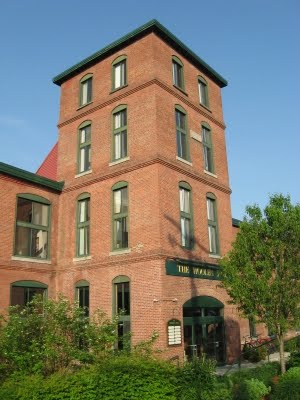
The old mill buildings really do look quite nice, I especially like this entrance to the Woolen Mill:


But I just think they would do better to be paired with new architecture more like these - both in Winooski, neither of them spectacular, but kind of interesting and reasonably handsome:


Sunday, April 24, 2011

By the water

Last Friday was Earth Day, Lenin's 140th birthday, my 38th birthday and, this year, Good Friday. The April 22nd I was actually born on (1973) was Easter Sunday.

Friday morning we were at a small beach town in Delaware, the last stop of a short vacation we took for the kids' spring break, cheap because it was the off season. I got up to run in the morning, it was in the low 40s and the boardwalk was nearly deserted. A sheet cloud covered the Eastern horizon far out over the Atlantic ocean, but as it approached the shore it gave way to small puffy clouds, close together like cobblestones. It was one of those rare moments when you can't see the sun, but its rays are visible shining down through cracks in the clouds, like the illustrations of God's love or holiness in those 14th or 17th century European paintings that so confused me in art museums when I was a little kid, befuddled by why anyone would want to paint so many pictures of a naked guy being tortured.

* * *

We drove back by way of scenic Route 9 along the Delaware coast, the "Coastal Heritage Greenway." The road is at places so close to sea level that there are numerous sign proclaiming that the road ahead is underwater if the lights are flashing, and so forth. Some of the land is farmland, some of it muddy tidal wetlands, a good portion of the latter protected as wildlife refuges.

At one point we drove a couple miles from Route 9 out to the actual shore, and stopped at what I'm guessing was once a fishing village, and is now a tiny pocket of poverty with a few people who try to make a living fishing. It had about two dozen small houses, a parking lot, boat ramp and a small pier which is closed from dawn to dusk unless you're fishing, and this ramshackle and abandoned structure:


Along with island nations and low-lying, densely populated areas like Bangladesh, this area of Delaware is almost certain to be covered by the ocean within a few decades. Unlike Bangladesh, it's not densely populated; the relative handful of I imagine mostly poor folks who eke out a living from the land and sea will be displaced into the rest of what passes for American society.

* * *

At that fishing village, we also got our first glimpse of the Salem Nuclear Power Plant, which sits on an artificial island between Delaware and New Jersey. It dominated our view all the rest of the way along the "Scenic Route," which oddly enough begins at an Air Force base and ends at an oil refinery.

Sunday, October 10, 2010

Homemade crackers with the kids


What with a looming danger of a full-time job in my immediate future, soon enough I probably won't be home in the afternoons with the kids. Not that I'm ever going to be as good a parent as the Sweet Juniper guy — I find it far too easy to ignore them now that they will occupy themselves reading or making WWII diaramas out of Lego or whatever it is they do upstairs — but I've been trying to plan at least one activity to do together with the kids each afternoon.

In practice, this has meant figuring out something to do with the boy, since the girl, now in middle school, has been playing middle-school soccer — meaning most weekdays we don't see her from 7:15 in the morning when she leaves home to catch the bus, until 5:30 at night when she gets home from soccer practice.

The boy really likes crackers, and I really like cooking, so a few weeks ago I enticed him into making crackers with me in part by showing him this video of Mark Bittman talking about and making crackers. So we made the Parmesan Cream Crackers (recipe here) and promptly ate them up. This afternoon, we repeated this with his sister helping out as well.


Here are the crackers after they were made (well, what was left of them after the kids & spouse had afternoon snack...):

Thursday, September 02, 2010

Spicy vegan "cream of" broccoli soup


I made this today to use up some broccoli that needed a home, vaguely inspired (sadly) by a recipe I read earlier in the week in a Hannaford "Fresh" magazine lying around the waiting room of the dentist's office. I wasn't really expecting it to be as delicious as it was. It is also a good way to use broccoli stalks and leaves if the people you cook for will only eat florets (like 2 people in my household).

2 stalks broccoli, chopped
1 onion, chopped
extra virgin olive oil
a couple of pinches red pepper flakes
white wine (I probably used about 1/2 cup)
1 can cannelini beans

1. Heat a little olive oil in a saucepan over medium-high heat and add onions and red pepper flakes. Cook until onions are starting to brown.

2. Add broccoli pieces and cook for a minute or two, until they turn bright green.

3. Add white wine, stir to make sure nothing's sticking to the bottom of the pan, and raise heat to high. Reduce white wine by half.

4. Add beans and just enough water to almost cover (you want to err on the side of less water: you can always thin the soup later with more water; thickening it is much more difficult). Season well with salt.

5. Cover the pan, bring to a simmer, and simmer for 15-20 minutes, until broccoli pieces are thoroughly tender.

6. Whiz up with an immersion blender, adding more water if too thick. Garnish each bowl with a drizzle of olive oil and some freshly ground black pepper.

Serve with toast or croutons.

Friday, August 27, 2010

Polenta-cheese chiles rellenos


Traveling to the midwest and southwest this summer, we ate at quite a few Mexican restaurants, and I took to ordering not a few chile rellenos, on the theory that when eating in a restaurant, you should order things that you generally don't make at home. A few were amazing — Café Castro in Santa Fe and El Mezcal in Lawrence, Kansas — most were pretty good, and only one was awful, smothered with so much meat sauce (!) and melted cheese that there were pools of saturated fat everywhere on the plate.

Nonetheless, after getting a couple of local poblano peppers at the Intervale Community Farm this week, I decided I'd take a stab at actually making them at home.

I started with Rick Bayless's recipe from Mexico One Plate at a Time. One of the great things about stuffed dishes, of course, is that they lend themselves so well to variation, and especially to meatless variations (not that I'm vegetarian, I just don't cook with meat a lot). Mixing some cooked polenta in with the cheese helped cut the richness of the filling without losing the creaminess, and, because it is zucchini season, I cut one up and added it to the broth for variation.

This recipe has a lot of steps, but there are also a lot of opportunities for doing things ahead — the only thing that really needs to be done at the last minute are reheating the chiles in the oven, reheating the broth on the stove, and sautéing the zucchini.

Measurements for some of the ingredients here are pretty general, because poblanos vary pretty widely in size. I probably used about 1/2 cup each of polenta and cheese, and maybe a few tablespoons of sunflower seeds, to stuff 3 poblanos. Making the batter with 2 eggs gave me more than enough for the 3 poblanos; I could easily have coated a fourth. I used some leftover potato-cooking water for the broth, which was perfectly acceptable, but I'm sure it would taste richer with chicken stock (veggie or beef stock might overpower the tomatoes).

Chiles
Poblano peppers
Lots of oil for frying

Filling
Cooked polenta (either leftover or store-bought), cut into small chunks
Jack cheese, shredded
Sunflower seeds

Tomato broth
Onion, chopped
Tomatoes, chopped or from a can
Cinnamon
Pepper
Water, stock or broth

Batter (for every 2 poblanos)
1 egg
1/8 tsp salt
1 tsp flour

Zucchini garnish
1 or more zucchinis, cut into 1/2 inch cubes
A few pinches of cumin seeds

1. Prepare the chiles by heating 1 inch of oil in a large pan to 350 degrees. I used a 12-inch Calphalon dutch oven, and probably about 1 1/2 quarts of oil. Drop the chiles in and cook for 1-2 minutes, until the skin is blistered all over. Remove, drain on a paper towel, and remove oil from heat.

2. Mix polenta, cheese and sunflower seeds together in a bowl. I used roughly equal amounts polenta and cheese, but proportions could be varied. I prepared the ingredients separately, mixed together as much as I thought I'd use, then when I ran out mixed together a little more. If the polenta is not well-salted (amy homemade polenta always is, but storebought — or yours — might not be), you might want to add a bit of salt here as well.

3. When chiles are cool enough to handle, rub off skins, cut a slit in the side and pull out all the seeds and membranes. Rinse out the insides gently, then stuff with filling. Secure chiles with a toothpick, place on a plate and flatten slightly, and put in freezer for 1-2 hours.

4. Meanwhile, make the broth. Sauté onions in a little oil until just beginning to turn golden, sprinkle with cinnamon and black pepper, and add tomatoes. Cook the tomatoes down for a few minutes, then add liquid and bring to simmer. Puree until smooth with an immersion blender and set aside.

5. Remove chiles from freezer and reheat oil. Separate egg(s) and beat whites with salt until they hold soft peaks but are not at all stiff. Add in yolk(s) and flour, and beat to combine. Once oil has come to 350 degrees, take however many chiles will fit into the oil at one time, dust with flour (shaking to remove excess), drop in batter to coat thoroughly, then lay* immediately in the hot oil. Rick Bayless says to spoon oil over the top, but I found this had the effect of washing the batter off the chiles, so I stopped doing it.

6. Cook chiles on one side for 3-5 minutes, until nicely browned, then flip over (2 metal spatulas was the easiest way to do it — the batter is so light that it's hard to grab the chiles with tongs without scraping the batter off) and cook on the other side the same amount of time. Remove from oil and drain on paper towels. If you have more chiles than will fit in the oil at once, repeat with remaining chiles.

7. Heat oven to 400 degrees. After all chiles have rested at least 5 minutes out of the oil, put them into the oven for 15 minutes on a baking sheet (lined with foil for easier clean-up if you're neat like that). This will crisp the coating a bit, render some oil, and heat the filling through.

8. While the chiles are in the oven, reheat the broth. Heat some oil in a large frypan over medium-high to high heat, add cumin seeds and cook until fragrant (30-60 seconds), then add zucchini cubes. Make sure each cube has one side flat along the surface of the frypan and then do not disturb for several minutes — you want to get a nice sear on at least one side of each piece of zucchini. Test a couple, and when they're nicely browned, stir the zucchini around a bit and continue cooking until nice and tender. Toss with salt and pepper.

To serve, for each chile place 1/2 cup of broth in a shallow bowl, nestle the chile in the middle, then spoon zucchinis around the chile.

* I almost wrote "lie" here, which would of course have been an instruction to the cook to lie down in the hot oil, rather than to lay the pepper in the oil.

Sunday, August 22, 2010

Hotcake crepes

One of the best food finds during our summer road trip this year was Pamela's Diner in Pittsburgh, which is known for "hotcakes" — large, crepe-like spongy pancakes, served rolled around fruit or other fillings with sour cream and maple syrup. They were amazing, thicker and spongier than traditional crepes — kind of like a sweet white-flour injera. This is my attempt to reverse-engineer them; I'm not sure I got it quite right, but these are still quite good.

I used a 12-inch nonstick skillet to make very large crepes and got 6 out of this recipe, but I imagine you could also use a 10-inch skillet and get more crepes which would still be large enough to roll around a filling. Flipping them is a bit of a trick; I slid the crepe off onto a plate and then flipped them back into the skillet.

2 1/2 tsp yeast
1/2 cup warm water (105-110 degrees)
1 1/2 cups milk
4 TBSP butter
1 1/2 cups flour
4 TBSP sugar
1 tsp salt
2 eggs

1. Mix yeast with warm water in a small bowl. Meanwhile, melt butter in a small saucepan; when melted, add milk and heat until warm (105-110 degrees).

2. Mix flour, sugar and salt together in a large mixing bowl. Add yeast to milk-butter mixture, then add liquid mixture to dry ingredients and mix well.

3. Cover batter tightly with plastic wrap and let stand for one hour, until bubbly and risen. Stir batter down, re-cover, and let stand overnight.

4. Stir down the batter, and beat in the eggs.

5. Heat a 12-inch non-stick pan over medium-high heat. For each hotcake crepe, lift the pan off the heat, add about 2/3 of a cup of batter and swirl around to cover the whole pan. Cook until bubbles appear and the crepe is browned on the bottom, then turn over and cook on the other side (several minutes per side).

6. Serve rolled around berries, jam or other filling, with maple syrup and/or whipped or sour cream.

Monday, July 19, 2010

Garden of Eden

Yesterday while driving across the high plains, I took the kids to visit the Garden of Eden in Lucas, Kansas. Built in the early decades of the century by one Samuel P. Dinsmoor, it is quite the bit of folk art and well worth seeing if you're driving across the country on I-70.


On the south end of this tiny town (population about 500) you come across this amazing concrete sculpture garden surrounding a house. Designed by Dinsmoor to be a tourist attraction, the house itself is pretty interesting. It is made out of local limestone (quarried just south of Lucas in Wilson, KS) but, instead of having the limestone broken into blocks as was traditional, Dinsmoor ordered long slabs of limestone and then used them like logs to build what he called his "cabin home."

Dinsmoor was really into concrete (a recent invention at the time) and he made all of the decor on the house (as well as the surrounding statuary) freehand — using his hands and shaping tools, but no molds — which is pretty impressive:


Well, no molds except the occasional beer bottle (this part was made during Prohibition, apparently):


You can go in the house (I'm not sure if that was the case the first time I came here, 20+ years ago), and see the storage/tornado safety cellar:


In addition to the house, he built a mausoleum for himself and his first wife, and had himself mummified (not wrapped up in fabric, but smoked to preserve the body). Per the old man's wishes, apparently, guided tours include a visit to the mausoleum to see his body. Another creepy bit in the mausoleum is a photo he was apparently very proud of: using two exposures, he took a picture of himself looking down on himself in his own casket.


But, of course, the real attraction are all the statues around the outside. Here is (not surprisingly) my favorite, the crucifixion of labor by the Doctor, Lawyer, Preacher and Banker:


And here is the Octopus of Monopoly Capital strangling the world (I'm not sure which bit represents this, but apparently one part of it is the octopus controlling the people by controlling their food supply — a timeless point, I suppose).


In another place, a man and a woman are using the "ballot saw" to regain their rights from the Octopus of Monopoly Capital:


In addition to the political parables, there are (not surprisingly, given the name), Biblical (and pseudo-Biblical) parables. Here, for example, is the all-seeing eye of God, being guarded by an angel with a flaming sword:


And the Devil in the corner, with God's hand reaching out to get him (apparently Dinsmoor thought the Diety could be a little more, ahem, active in trying to, you know, suppress evil and reduce human suffering and so forth)


His first wife apparently got tired of him being outside sculpting all the time, so he built a little face of himself waving into the kitchen window at her (the kitchen was in the basement):


Some more statuary:


When I first came here in the late 80s, it was kind of hard to find (it had just been purchased by a group of "grassroots art" people) but now it has apparently spawned a kind of "grassroots art" renaissance in Lucas, with a Grassroots Arts Center and this big old, I guess, commemorative plate by the highway as you come into town:

Friday, July 16, 2010

Our buried veins

I went to visit the Ludlow Massacre Monument today, in southeast Colorado. On my way down I-25 on Monday, I must have either missed the signs or been in too much of a hurry to stop.


The Massacre occurred in 1914, and the United Mine Workers of America raised the monument in 1918, but the story is rarely told in standard history books, and when it is, it is usually buried in a sidebar and isolated from its political context.

The miners of southeast Colorado came from Mexico and from all parts of Europe and spoke 24 different languages between them. They suffered injuries and deaths in the mines at a rate ten times that of their contemporaries in the East. As with so many organizing efforts, differences between the workers was the greatest obstacle to getting justice from the boss, but they succeeded, and in September 1913 they all went out on strike, together.

Their unity terrified the bosses, and provoked a barbaric response. Workers and their families were evicted from their homes (which were on company land), not even being allowed to take their possessions with them. The National Guard and state militias funded by the companies were sent in to suppress them, but they held strong. The union leased land and they built tent cities, in Ludlow and elsewhere, in which they braved the bitterest Colorado winter in recent memory.

After seven months on strike, and the day after celebrating Greek Orthodox Easter, the state militia provoked the Massacre — opening fire on strikers and their families, and burning down the tent city in Ludlow. Two women and ten children perished in the blaze, and five men and one more child were killed by gunfire.

They didn't win the strike — or, indeed, win union recognition until 1935 — but the violence did not break the strike in April. They held out until December, when the union ran out of funds and workers decided to return to work.

Though kind of out in the middle of nowhere, and unattended, the monument does have a guest book, kept in a box. The current book was full of names from the past two months, most accompanied by comments, many of them quite moving. This was my favorite:


("God bless the working people of the world, and teach big capital the generosity & compassion that the working class lives & loves by everyday. We are all connected")

* * *

The city of Trinidad was the economic center of the coal mining industry in southeast Colorado. While most of the mines have shut in recent decades, Trinidad seems to be hanging on better than many de-industrialized areas, and it has an attractive downtown with a mix of coffeehouses and art galleries, blue-collar bars and auto-body shops. Most of the buildings, and many of the streets and sidewalks, are made of brick.

It also has two monuments, erected by the Hispanic Chamber of Commerce of Southeast Colorado, both monuments to the dangers of mining. The first honors and memorializes the miners who died in the mines, the second the canaries who served (and often died) as organic carbon monoxide detectors in the days before electronics:


My guess is that the "regular" (i.e., white) Chamber of Commerce would never have honored Max B. Foster and Archie Struthers and Ivan Zorich; it's good that they have the likes of Jose Canuto Barron and Reuben Nunez and Epifanio Martinez to look out for their memory.

* * *

Before World War I, German-Americans were the country's largest ethnic minority — and they were an ethnic minority, with their own churches, bars and restaurants, in which they spoke German, ate foods unfamiliar to most "Americans" and raised the suspicions of many a "patriot" — especially as German-American workers were frequently at the center of labor struggles. They were neither "legal" nor "illegal," documented nor undocumented, because the U.S. had passed no laws whatsoever regulating immigration from Europe (prior to the Immigration Act of 1924, the only immigration regulations were prohibitions on specific nationalities, such as the Chinese Exclusion Law).

The U.S. entry into World War I unleashed an intense wave of suspicion of German-Americans, and an intense campaign to suppress Germanness, especially in the upper midwest where German immigrants were a particularly high percentage of the population. Towns named "Berlin" by German settlers were renamed. German churches which didn't convert to English (most did) were vandalized, their ministers paraded around town by "patriotic" mobs. When this is discussed in history books — if it is at all — it is mostly characterized by the somewhat comical attempts to rename saurkraut "Liberty Cabbage" (the ancestor of this century's "Freedom Fries").

The vast majority of German-Americans responded to this by trying to become good (white) Americans, but it didn't give them all a free pass. When I visited the Los Alamos History Museum yesterday, there was a temporary exhibit about the internment of German-Americans during World War II. Over ten thousand German-American citizens and German residents of the U.S., as well as over four thousand German nationals residing in Latin American and Carribean countries were rounded up by the U.S. government and placed in internment camps, despite no evidence of espionage, much like the more well-known example of internment of Japanese-Americans. Some of them, including some who were Jewish, had fled Germany to escape the Nazis. Some were forced, by the U.S. government, to return to Germany during the war, where they were generally treated as American spies.

I think sometimes we on the Left underestimate the amount of violence and coercion that went into making white people "white" — it wasn't just the carrot of white privilege, there was also the stick of "Americanization." Of course, it pales by comparison to the genocide of native peoples and the enslavement of Africans that are at the heart of white supremacy — I'm not trying to make the kind of "my people suffered too" argument that many of the Right make to obscure the reality of racism. But I think that maintaining the historical memory of things like the forced Americanization of German immigrants helps us grasp that white supremacy is at its heart a system of violence and coercion, not merely prejudice.

* * *

After lunch at the Ludlow Memorial, I drove up Route 12, the "Highway of Legends," a two-lane road that follows the Purgatoire River (or "River of the Souls in Purgatory") up west into the mountains from Trinidad. It was advertised as a "scenic byway," but most of the scenes were of coal and coal extraction.

Just past the Army Corps of Engineers lake at the foot of the mountains lies Cokedale. It's a former mining town (the mine closed in 1947) which still has about a hundred folks living in it, just outside the Romanesque ruins of the old coke furnace.


Across the road from Cokedale is a massive slag heap; it's been there since the 40s (and before). According to the historical marker sign, on hot days the slag heap becomes hot enough to generate steam of its own accord.


Driving up Route 12 is much like driving up any other small road following a river valley up the mountains — except that the exposed layers of rock are clearly rich and black with carbon. Apparently the coal mining industry in the area and revived somewhat in recent years with the use of hydraulic fracturing, or "fracking" (that's the same process they're using to get oil out of the tar sands in Alberta).

I don't know whether the apparent instability of the rock faces alongside the road (there are almost constant "Falling Rock" signs) is due to the fracking, or the old coal mines, or just the instablility of the rock, but it has apparently inspired some desperate measures. Several miles west of Cokedale, and just past the big operations of "Pioneer Natural Resources," they tried to hold back the rock face with a layer of concrete (which is now cracking) — a sad and failing attempt to paper over the open veins of our energy-hungry society, of the consequences of our past.