Wednesday, July 14, 2010

Santa Fe: art goes to market

Visiting a city where you don't actually know folks is always difficult, especially if it's a medium-sized city that is geared towards wealthy tourists. Nonetheless, I spent a day and night in Santa Fe while on the way to Albuquerque, out of a vague sense that it was a cool place that I should see. Maybe this dates back to high school, when I had a friend (now a poet of some renown) who was a little obsessed with St. John's College.

Turns out, downtown Santa Fe is a bit like Taos on steroids: art and wealthy people. The same adobe architecture everywhere — here is a luxury hotel downtown:


Unlike Taos, however, the adobe is also broken up with some fairly attractive Spanish-style architecture: here, the performing arts center:


It was also hot, though the old saying about dry heat being more tolerable than humid heat turns out to be true, and the interior courtyard of the New Mexico Museum of Art was noticeably cooler than outside:


* * *

Downtown Santa Fe is, in many respects, very similar to downtown Burlington: a shopping and dining playground for the wealthy with a slightly bohemiam flair. It has fancy restaurants, aggressive panhandling, mediocre blues/funk bands playing in the park on summer evenings. But in one way it is shockingly different.

Santa Fe is apparently the second-largest art market in the US. The largest of course is New York City, but New York is so large that you can visit it time and time again and rarely (or never) come across an art gallery. Downtown Santa Fe, however, must be 75% art galleries, or expensive handicraft shops, etc.

Obviously, art is going to be commodified in a capitalist society — everything is, more or less. And at some basic level art is also the personal vision of the artist, and that can't be taken away. But in our little backwaters like Burlington, art is also play, it is community, it is something to do with our children. And in museums it is a social good, a collective heritage.

Santa Fe is the dark underbelly of art under capitalism: a reminder that the "art world" can only exist on the foundation of this massive commodity exchange, where the beneficiaries of capitalism's shocking inequalities of wealth stroll through heavily air-conditioned rooms, appraising beauty-objects priced at thousands and thousands of dollars, behind plate glass windows to make their power clear to all in this desert city.

Tuesday, July 13, 2010

Socialism and love

In the first union local I was involved in, we used to talk about "surrounding people with love." Not everyone, mind you — we weren't total hippies, just graduate employees. It was just a term we used for how to approach people who basically "got it" on a values level (that we deserved fair treatment and reasonable pay and benefits from the boss) but were confused by some combination of misunderstanding of unions or over-investment in their own (potential) professional status or wack ideas from the dominant culture.

My friend Steve Williams recently wrote a piece over at Organizing Upgrade proposing that we (the Left) "take up the challenge of developing a blueprint of 21st Century Socialism." I've been thinking about this a lot recently — before, during and after the US Social Forum in Detroit, while staring out the window on the car trip or lying awake at night during one of my many bouts of insomnia. Like many people, I feel a sense of urgency about the climate crisis, and — like too few people — I am convinced that the crisis cannot be solved within the capitalist system.

* * *

My in-laws, with whom I spent the bulk of the last week, are all good people, but they have a wide range of political, religious and cultural beliefs. Or, rather, I should say, almost all of them have political, religious and cultural beliefs that are vastly different than mine, and somewhat different from each others'.

If I'm serious about being a socialist, then part of the vision needs to be a vision of how people like my in-laws — including at least one or two who enthusiastically voted for W — are eventually brought to being committed to the project of building a new world based on human needs rather than profit. Not overnight, of course — given the current social, political and economic arrangements in the U.S., a transition to socialism would, in fact, mean that many white middle-class folks would lose a variety of "privileges" (large houses, SUVs, the psychological benefits of white privilege, etc.), so it would not seem to be in their short-term interests.

Still, to build a socialism for the 21st century, we will eventually need the positive commitment from the vast majority of people, including even a big chunk of the white middle class in the U.S. (capitalism, by contrast, can accomplish its main goal — accumulating profit — without anyone being committed to it at all; only problem is it destroys people's lives and ultimately — soon, in fact — will make the planet uninhabitable for humans).

I'm not saying that socialist strategy should be based on reaching the white middle class — we obviously have our work cut out for us in the immediate period just organizing the working class, overcoming white supremacy and patriachy, building internationalist consciousness, etc. We need to be strategic, but at some core place, we also need to have a long-term vision that surrounds everyone with love.

* * *

Growing up as an athiest in the Bible Belt, I've always been extremely touchy about religion — to the point where any real discussion of spirituality is a bit of an emotional trigger for me. If I'd been simply raised in a different faith — Judaism, Islam, Catholicism (not considered fully Christian in some parts of the Bible Belt), etc. — it probably would have been easier. I think most ordinary folks had it sufficiently beaten in to them in the last half of the 20th century that it's not OK to argue with or denigrate or try to convert people of other faiths, but athiests seem to receive less of that respect. Not that I was beaten up or anything, and not that it was particular horrible or had any lasting impact on my life chances — it was just the one axis on which I experienced the "you don't fit societal norms" that people of color, women, queer folks, etc. deal with every day.

But obviously, this is wrapped up in questions of power. And, in fact, I am noticably more touchy about religious talk from white, middle-class folks (and from Protestants) than from people who have less structural power in society.

Which has actually got me thinking — uncharacteristically — about whether separation of church and state might be one of those things that is less of an absolute value than a tactical neccessity for dealing with an unjust society (like affirmative action, for example). When religion is no longer used to prop up and maintain inequities, does it become something (like musical taste for example*) where we can all be comfortable with each other, even in "public" settings?

Concretely, the question I've been thinking about is this: My sister-in-law is a teacher who has given up a huge amount of pay (relative to what she used to make in the public schools) to teach in a Christian school. She seems to have a great philosophy about teaching (explicitly treating children like people), and my gut feeling is that she is probably a much better teacher than some of the folks at my kids' school. Would I be comfortable — again, in a just society — with her teaching in the way she wants to teach, being explicit about her Christian values, in some kind of public school like the one my kids go to (where there might well be more Muslims than Christians, and where Protestants are distinctly in the minority)?

Can we imagine a socialism where that is possible?

*as long as you don't make anyone listen to Phil Collins. That is just not acceptable under any social system.

Monday, July 12, 2010

South through Colorado, then across northwest New Mexico

Believe it or not, almost all of the driving on this road trip so far has been done by tireless spouse H, except for a 60-mile stretch in Iowa along US 6, during which H (and the kids) slept. This is because H doesn't like being a passenger, and, when not sleeping, conveys this dislike through fairly regular criticism of the driver (usually silent criticism if the driver doesn't happen to be a spouse, whom one can freely criticize...)

But today H flew home on account of having a real job and having to get back to work (3 driving comments during the 30-minute trip to the airport), and we are leaving the kids with H's mom for the week, so I am off to New Mexico, for a little bit of solo travel and a little bit of organizational exchange with the South West Organizing Project in Albuquerque.

After leaving the airport, I drove south on I-25 through the seemingly endless exurbs of Denver, then the suburban-religio-military complex that is Colorado Springs, which was kind of a depressing way to start the day.

South of Colorado Springs on I-25 comes Pueblo, a small industrial city which still has some signs of industry, believe it or not. One of those signs is a bit south of the city, an oil refinery with one, prominent wind turbine displayed out front:


After Pueblo it is pretty empty out there on the plains, and I got pretty bored of driving on the interstate. In part because construction made it difficult to see and access the exit, I failed to stop in Trinidad, which is too bad, because, at least from the interstate, it looked like it had a nice downtown, and I was definitely needing to get out and stretch my legs. Instead, I drove across the Raton Pass into New Mexico, and stopped at the New Mexico Vistor Information Center in Raton, which was kind of out in a strip of Denny's and Sonics and such like, and not such a great place to stop.

On impulse, while looking at the map and thinking about another three hours on the interstate to get to Santa Fe, I decided to cut across on US 64 to Taos instead. The first thirty or so miles were easy driving, a nearly empty two-laner across nearly flat plains:


But then, past Cimarron, the highway started snaking up into the mountains, and I think between all the curves and everything I maybe averaged 30 miles per hour, taking two hours to get up and across and over to Taos. It was beautiful, though. I even stopped at the Palisades Sill, a layer of igneous rock that the Cimarron river has cut into:


* * *

I'm not sure what possessed me to go to Taos, other than perhaps the lyrics of an obscure Jules Shear song:

On his eighteenth birthday, Jimmy Taylor rode to Taos
With his girlfriend Lucy, to rob a bank and buy a house


The ubiquitous adobe architecture in the downtown area makes Taos look a bit like if Stowe had been built by the Barbapapas — or at least by Barbapapas who were primarily interested in selling art and a kind of art/nature lifestyle to rich people rather than creating an eco-anarchist paradise.


Instead of browsing the expensive art, I paid 25 cents for some parking time and wandered around downtown for awhile, then found a grocery store and had a lunch of yogurt, apricots, crackers and lemonade for $5.75. Taos on six dollars a day.

Clearly, rain is not a problem in Taos. Designing your roofs so that rainwater pours out onto your customers' cars would not fly in Vermont:


(incidentally, that Durango from Texas parked next to me was running its engine — someone was napping in the passenger seat — during the more than an hour that I was parked there)

It was interesting, but I wasn't sad to leave. On a final note, even the Walmart in Taos has an adobe look to it:

Saturday, July 10, 2010

Western State College, or, the Novosibirsks of American academia could be worse

Gunnison, Colorado — where I've been staying for the past week — is also home to Western State College, a public 4-year liberal arts college. Wandering around the campus the other day (which runs up against a park the kids & their cousins were playing in), it occurred to me that had I pursued the Ph.D. I supposedly entered graduate school to achieve, I likely would have ended up in a place very much like this.

I think probably anyone who enters graduate school in an academic discipline, with the intention of becoming a professor, at some level at least secretly harbors fantasies of teaching at a prestigious institution — maybe not Harvard or Yale or Princeton, but at least a major research university like the Universities of Wisconsin or Texas or so forth — and doing important research. If you're interested in changing the world and not just studying it, you want to be Robin D.G. Kelley or Peter Rachleff — or at least in a large urban area where there are movement institutions you can be part of, or a celebrity supporter of, etc.

The reality, though, is that most folks are going to end up in out-of-the-way places like Gunnison, political action limited to an Obama bumper sticker and buying organic vegetables at the farmers' market, desperately trying to engage ill-prepared students in the excitement of, say, labor history, knowing full well that even those you reach are going to slip back into the miasma of American anti-intellectualism as soon as they are out of school.

* * *

That said, Western State appears, like Gunnison, quite charming — it could certainly be worse. What I presume are the original buildings have a kind of nice stucco and slightly Spanish architecture to them:


Like most college campuses, there are some unattractive blocks built during the 60s expansion of higher education:


No college is complete without a brand spanking new student center built in 90s bland-o-rific style:


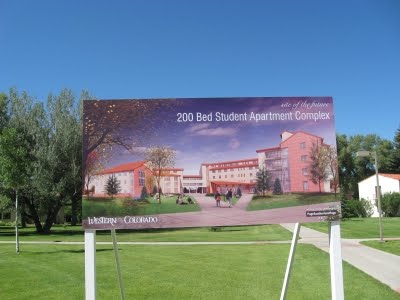
And, most importantly, a billboard advertising new building projects:

Gunnison, Colorado

We've spent the past week family-reunion-izing with H's family in Gunnison, Colorado — not really H's hometown, so much, but one of the numerous places they lived (and arguably the real hometown for younger siblings), and where the family matriarch currently resides.

Gunnison is in a broad, fairly flat valley just west of the continental divide. The house we stayed at is in an area just outside of town of ranching land being slowly turned into suburban residences:


... and with some nice sunsets.


The town itself is quite charming. The clear absence (or perhaps just weakness or poor taste) of any kind of Design Review Board has led to a kind of anarchic approach to architecture which would never have arisen in the more conservative building approach of New England:


(the second house apparently being designed so that small performances could be given on the stage in front of the house — a disturbing thought, given the loud and apparently drunken debates about the artistic merits of various Lynyrd Skynyrd songs coming from the back of the house at 11am)

The freewheeling architectural style has also apparently given rise to a creative approach to greenbelts, such as this embanked and stone-walled one:


However, the most curious aspect of downtown Gunnison is the fact that, on either side of the north-south streets (though not the east-west ones), run foot-wide irrigation ditches — the maintenance of which is presumably a municipal responsibility. Most of them are simple dirt ditches, but I did find one concrete-lined stretch:


Residents do in fact install pumps to pull water out of these ditches to irrigate their lawns, sometimes covered with little huts:


And, naturally, no 9-year-old boy could resist the temptation of travelling by jumping from one side of the ditch to the other (although I had my camera ready to catch it, he did not in fact fall in):