Thursday, November 15, 2007

This week in France...

We believe in the power of the street. In France, all our social battles were won on the street. It's always been like that and it always will be. This is about the kind of society we want. Do we want liberalism to reign, or do we want a society of social support and equality?
—Adrien Bouzard, 22, second-year anthropology student at Nanterre university


Guardian

Friday, October 19, 2007

Shell beans

Like sentences, shell beans are a great deal more trouble to produce than anyone who isn't producing them knows. You have to shell the beans, slipping open the pods with your thumbnail and then tugging the beautiful little prismatic buttons from their moorings — a process that, like writing, always takes much longer than you think it will. And then even the best shell beans, cleaned and simmered, are like sentences in that nobody actually appreciates them as much as they deserve to be appreciated. Shell beans are several steps more delicious, lighter and finer, than dried beans, much less canned beans; but the sad truth is that nobody really cares beans about beans, and not many eaters can tell the fresh kind from the dried, or even the canned.
—Adam Gopnik

Sunday, March 25, 2007

Revery alone

Like many people who cook a lot, I have a vast number of recipes that are not in cookbooks — they were clipped out of newspapers or magazines, jotted down on scrap paper while paging through cookbooks at someone else's house, came with the package of won-ton wrappers, and so forth. I often clip, copy or save them because they look interesting, they go into an accordion file and are promptly forgotten, because unlike untried recipes in cookbooks, which you see every time you page by them en route to your favorite recipe, they just sit there, alphabetized by their title (which may reflect their main ingredient, their ethnic origin, or the first name of someone else's grandmother) in the dark in the accordion file.

For the last year or so I have put newly-clipped recipes into a separate folder of "untried recipes," figuring that I am more likely to actually try them if I have a folder I can flip through when looking for inspiration, and more likely to realize that some things (like a "Tex-Mex appetizer" made with Pillsbury pie crust) were not, in fact, worth clipping. Finally this weekend I went through the accordion file itself to pull out any untried recipes.

I found all sorts of interesting things, including a set of handwritten recipes on index cards sent to me by an English major I used to date — if I recall correctly, the recipes were sent during an uncertain point in the relationship, when graduation had made for a long-distance toss-up as to our future (it ended badly, as you might imagine). Among the recipes was this:

Quartet for Four Beer-drinkers

From your pint glass
take a swig of beer
whenever you feel like it

When you are not actually drinking
strike your glass
with an implement

sometimes quietly
sometimes loudly

Let there be silences between your attacks

Continue
until all four glasses are empty

— Wendy Cope


* * *

The snow cover is finally starting to melt off in Vermont. Wide swaths of green (and brown, there's more mud than grass in much of my neighborhood) are becoming visible among the greyish frozen slushiness of urban snow cover. A few bulbs are starting to poke out of the ground, our ground phlox in the front is beginning to green, the few bushes we have seem to have been spared by the sidewalk ploughs this winter. I am eagerly anticipating the first meal I can garnish with fresh chives gathering from along the side of the house.

We've had a winter share from a local CSA this winter, which has meant a lot of root vegetables. Root vegetables are great, comforting and filling and warming in their long cooking times in the oven in the winter, but they do, generally speaking, require a lot of cooking work — peeling to remove their thick coats and spicing to prod their heavy slothfulness and greasing with rich fats to lubricate their dryness and long simmering, baking or roasting to bring them to the fullest flavor (RECIPES at blog.myspace.com/domesticleft).

Nonetheless, I'm ready for the vegetables of spring, perfect with a quick slicing and a light dressing and a sense of wonder before them.

* * *

On Saturday we went to a decent-sized antiwar rally and march downtown. Because the nationwide anniversary-of-the-war actions last weekend coincided with the University of Vermont's spring break, the students had decided to organize something for the 24th, and were also joined by a respectable contingent of labor folks (the crowd we were among) and the "usual suspects" of middle-class liberaldom.

The speeches started off painful, as they so often are at local peace rallies, at least around here. Because, much as I've always believed that social change comes about when people assemble and listen to lengthy speeches from well-meaning students and socialist professors and passionate liberals that detail their own intricate grasp of statistics and history, well ... OK, so I've never believed that.

Then the veterans spoke.

Not the old "Veterans for Peace" folks, who are great but mostly give long-winded speeches that detail their own intricate grasp of statistics and history. The veterans from Iraq. There's probably a more powerful critique of the war than a Marine describing the safest drive he ever took in Iraq (he wasn't shot at once. Because he was driving over the dead bodies of Iraqi men, donkeys, women, camels, children slaughtered by his battalion the night before). But not for me right now.

* * *

Also from my recipe folder (same source):

Emily Dickenson's All-Natural Outdoor Recipe

To make a prairie it takes a clover
    and one bee —
One clover, and a bee,
And revery.
The revery alone will do
If bees are few.
Tuesday, December 12, 2006

Compartmentalization


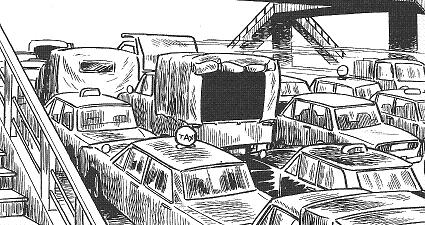
I've been thinking a lot recently about the latest blog post from yes! this is Nick Robinson about traffic:

There is a real horror in being forced to use deadly, destructive machines to get to work and back. After all, almost 43,000 people died in 2003 in accidents ... without reason, except for the routinization and acceptance of terror on our commute to work and leisure.


and how our automobile culture is related to the social division of labor — he quotes Andre Gorz:

it never occurs to you that work, culture, communication, pleasure, satisfaction of needs, and personal life can and should be one and the same thing: a unified life, sustained by the social fabric of the community.


* * *

Last week I read "Abandon the Old in Tokyo" by Yoshihiro Tatsumi, a series of short comic stories. In the interview at the end of the book, Tatsumi describes the era he was writing in, and about:

Japan was destitute after World War II, but by the late-'60s, it entered its period of high-growth economics. Economic development was considered more important than the way people actually lived their lives.


In the title story, a man lives with his aging and infirm mother in an apartment building where everyone still does their laundry (including his mothers' frequently peed-upon bedclothes) in a shared washtub. Meanwhile, the man works as a garbage collector, one of his coworkers finding a washing machine that just needs a simple repair. "Doesn't matter how handy it is. People get rid of anything old."

* * *

For the first time this year, there are actually more poor people living in America's suburbs than there are living in its cities (in absolute numbers; the percentage of people in poverty in urban areas is still higher).

Friday, December 08, 2006

Vocabulary

The other night, I took E to see the modern dance company Pilobolus. She is very much into dance (ballet especially, of course, but with a healthy appreciation for other forms of dance as well).

I enjoy dance, but I can't say that I have ever before been completely entranced by an entire dance performance. The program talked about how Pilobolus uses collective improvisation to create a new "vocabulary" for dance — different than the "vocabularies" of ballet, or modern dance, or hip-hop — and the results are in fact strikingly original. "Memento Mori" wasn't so much dancers dancing the parts of a marriage, but dancers who had so closely observed the physical vocabulary of a marriage — the grimaces, grins, preening and poking, exasperations and expectations that our bodies develop for each other during long companionship — and used them to create a piece of art that was very classically structured (unlike most marriages).

* * *

I've started a new job, and a new blog. The new blog is at MySpace, and it's just about food. What I've cooked and how to cook it. I've moved a post or two over there from here, posts that were, for the most part, just recipes. I also deleted a few posts from this blog which were just notes about news or such — I'm trying to keep this to be just, ahem, writerly things.

My new job is primarily writing. My official title (officially conferred upon me on Wednesday) is "Assistant to the Director of International Affairs," but basically I am a grant-writer. Clear narrative, careful attention to crafting our proposals within the shade of political language preferred by each grantmaker in turn, and most importantly: meeting deadlines. I like being clear, ferreting out shades of politics and I'm pretty good at making deadlines.

But I do have issues about writing as work. Flipping burgers is work, running machines in a factory is work, serving customers is work, teaching is work. And really, writing is work, too, but it has been so tied up in my mind with privilege that, before starting a writing job, I've always tried to write (both the blog and writing leaflets, etc. for the movement) in the corners of my time — during down time at work at my customer-service job (I'm fine with using the boss's time), or if I wake up early because of my occasional insomnia, or on the weekends when the laundry is all done and the house is fairly clean and H has taken the kids off somewhere.

* * *

I first read blogs about two and a half years ago, mostly mommy blogs, primarily the excellent though long-defunct days of the week, but also dooce and fussy and some others (until they all blogged about proudly crossing picket lines at a mommy-blogger-convention in SF — I haven't looked at them since). Now that the kids are older, more person-like at 6 and 8, I suppose I don't feel like I need even the minimal validation of reading blogs about other parents who are also driven crazy by the mysteries of small-child-behavior, who form the online bad, but not so bad, parents club.

I never felt much kinship with other "stay-at-home dads," probably because most of them were still men, and they either retained too much manliness and wanted to talk about sports, or were too into renouncing their manliness and wanted to talk about feelings. I liked the mommy-blogs because they spoke the vocabulary of the Small and Daily and Material, not the Big and Important.