Tuesday, August 11, 2009

By the skin of our eggplant


So today a grilled eggplant salad recipe was the featured recipe on Mark Bittman's blog, and I thought, "hey, I've got some grilled eggplant in the fridge" — but since it's been so hot and humid the past few days, I thought the whole-milk-yogurt dressing might be a bit heavy. Plus, I had some cherry tomatoes that needed a home, and wanted to make it a main dish by adding some garbanzo beans (canned, I'm afraid), so I opted for an olive-oil dressing instead.

I cut off the skins as per the Bittman recipe (it was a large eggplant from the CSA which I had grilled in thick rounds, mostly for sandwiches) and then my New England working-class "waste not, want not" complexes kicked in, and I suddenly couldn't bear to compost the eggplant skin sitting on my cutting board.

My solution? I minced the skins into 1/8" x 1/3" (the thickness of the grilled rounds) pieces, tossed them in a small bowl with plenty of salt, red wine vinegar, and red pepper flakes — making a kind of quick spicy pickle, which worked perfectly as a garnish. The skinless cubed chopped eggplant was meltingly tender, the small bits of briny, spicy skin added piquancy and a kind of olive-like chewiness.

(Seen here with the perfect side vegetable — New England sweet corn, picked that day, cooked in boiling water for exactly 60 seconds. So perfect it needs neither salt nor butter)

Wednesday, July 29, 2009

The cool delight of soba and silken tofu


Since summer has finally arrived in Vermont over the last week or so, I've been trying to plan meals that don't involve much application of heat, or at least whose cooked components can be cooked in the relatively cooler morning. Especially I've been enjoying the wonderful versatility of having cold cooked soba (Japanese buckwheat) noodles in the fridge.

Classically, they can just be rinsed off (to remove excess starch) and then served cold with a dipping sauce, which is very good, but they also make a great base for salads. Here, they're tossed with shredded lettuce, sesame seeds and toasted sesame oil, then drizzled with a mixture of 3 parts soy sauce, 1 part mirin (sweet Japanese rice wine) and 1 part rice vinegar.

For the main protein for the meal, I opened up my favorite kind of silken tofu — the Mori-Nu boxes which have a shelf life in the pantry of a couple of months — topped with well-drained tuna packed in water (I discovered a few cans of white albacore in the pantry — from one of the rare shopping trips entrusted to H, no doubt, as I would not myself splurge on such a luxury — but it did taste exceedingly good), drizzled with the soy-mirin-rice vinegar mixture and then garnished with chopped scallions. Not exactly a recipe, but a delicious summer meal.

Tuesday, July 07, 2009

Waterfront Sculpture

Waterfront Sculpture

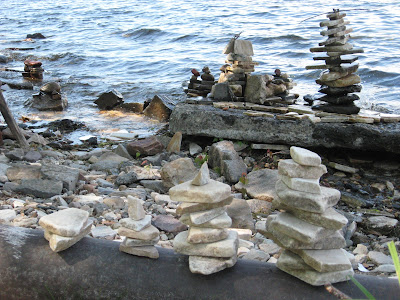
Intrigued by an article in the paper, the kids and I went down to the waterfront yesterday morning to check out the Andy Goldsworthy-esque sculpture a couple of 19- and 20-year-olds made with rocks. Most of it consisted of piles made of the unusually flat rocks down by the waterfront:

Piles

My favorite part was this path into the lake:

Path to the Lake

S decided to add his own contribution:

Adding to the sculpture

In addition to stone, it also incorporated a fair amount of the rusty metal bits that litter Burlington's once-industrial waterfront:

Table of Rusted Items


* * *

Burlington's waterfront was not always primarily a tourist destination — in fact, it was fairly industrial up until the seventies. In the 19th century, the waterfront was a huge transportation hub — Burlington was built on a bay which made it ideal for shipping goods on Lake Champlain, either north to Quebec or south to New York, and soon enough the railways came as well — just inland from where this sculpture is there is still a huge switching yard.

Vermont's economy in the 19th century was powered by resource extraction: timber, granite, marble. In the days before refrigeration made commercial dairy farming possible, commercial agriculture meant sheep farming — Vermont is actually more forested now than it was 150 years ago, as land formerly dominated by grazing sheep became reforested. Industrial production meant woolen mills. The built environment of Burlington and neighboring Winooski is dominated by 19th century mill buildings, some turned into condos and offices and boutiques, some converted to heavier industrial use in the twentieth century and now abandoned and toxic.

Like poor rural areas historically, Vermont soon attracted industry as a low-wage, non-union alternative to production in Massachussetts, New York or Connecticut. In the 1940s, organizers for the UE — the CIO union with jurisdiction for machine tool manufacturing — found machine tool factories in Springfield and Windsor where workers were making a fraction of their counterparts elsewhere in the Northeast.

Of course the bosses moved the work to poorer and more rural areas, especially after workers successfully organized. Vermont's industry moved to the US South, to Mexico, to China. And as Vermont de-industrialized, the economy turned to that other mainstay of poor rural areas (at least the picturesque ones), tourism.

By the seventies, it was clear that the potential beauty of Burlington's de-industrializing waterfront could make people wealthy. Whether development of the waterfront would be primarily public or private was one of the key issues in the 1981 mayoral race, in which the then-more-socialist-than-he-is-now Bernie Sanders broke the grip of a corrupt Democratic Party machine on Burlington's city government, running in part in opposition to a plan to develop the waterfront as private condos. As a result, we now have a public bikepath that spans the length of Burlington's waterfront, a public boathouse and large public park at the center of the bay (right by downtown), a science-and-ecology museum, and some other stray amenities such as an off-leash dog park and a skatepark, all with stunning views of the lake and, across the lake in New York, the Adirondacks. All this public land, together with the downtown pedestrian mall (also a product of Sanders' municipal socialism), no doubt create far more economic activity for local businesses than condos for the wealthy would have (there are still condos for the wealthy; they're just set back behind the public parks).

* * *


While the bike path runs along the whole waterfront, not all of it is developed. South of downtown, the bikepath runs for about a mile along the edge of the lake, while just east of the path is an industrial and former-industrial area of railyards, water sewage treatment, trucking terminals and brownfields, and at least one Superfund site. You can't get from the bikepath back to the rest of the city during this mile stretch, and the actual "beach" of small rocks where the water meets the land is filled with rusty metal.

Just south of the water sewage treatment plant (and just north of the temporary sculpture above), there is an odd, and more permanent, piece of public art which commemorates the fact that white marble was found and dug at this spot, and in fact that marble was used — along with other rock — to stabilize and create the Burlington waterfront. Several large pieces of marble are placed along the waterfront, seemingly at random, and some of them carved to look, presumeably, like the detritus of some ancient civilization, both the strange mythical lake creatures that they worshipped:


... and the curious devices that they used for transportation:

Thursday, July 02, 2009

Beet and shiitake bing with greens


I'd never made filled bing before, but everyone in the family is quite fond of green onion pancakes, which are made with the same hot water dough, so when I saw my TV chef idol Ming Tsai's episode featuring several different kinds of bing, I figured I should try it out. Then on Monday we got a nice bunch of beets with greens still attached from the CSA farm, and inspiration struck to serve the bing with greens and a sauce on top (rather than the more traditional dipping sauce).

If you want to be most efficient on time, cook, peel and chop the beets ahead of time, then proceed in this order about 45 minutes to an hour before you want to eat: soak dried shiitake (unless using fresh), make dough, make filling, prep sauce ingredients, make bing, fry bing & make pan sauce.

Hot Water Dough
2 cups flour, plus additional as needed
1/2 tsp salt
1 cup boiling water
1 1/2 TBSP canola oil

Combine water and salt in a mixing bowl, then pour in boiling water and oil and mix with a wooden spoon until the dough comes together. Knead for about five minutes or so, adding flour as necessary to keep dough from sticking to the counter, until smooth (it won't get as smooth and elastic as bread dough). Form into ball and allow to rest for at least 20 minutes.

Filling
4-5 scallions, white and light green parts, chopped
1 tsp minced ginger
1 bunch of beets (4-5 small to medium), greens reserved, roots boiled until tender, peeled, and chopped
8-10 shiitake mushrooms, fresh (or dried and soaked in hot water for 20 minutes), sliced
a little canola oil
dash of soy sauce
freshly ground black pepper

Heat the oil in a small frypan and sauté the scallions and ginger for a minute or two, then add shiitake and cook for a few minutes if dried; until well browned and liquid evaporates from pan if fresh. Add beets, a splash of soy sauce and a good grind of black pepper, mix everything together well, and remove from heat. Let cool.

Forming and Cooking the Bing
1. Divide the dough into 8 balls, and roll each ball out into a 6-8 inch disk, about 1/8" thick in the center and thinner on the edges.
2. Place about 1/2 cup of filling in each disk, then pull up the edges around the filling and twist to seal. If it's sticky, dust top and bottom with a little additional flour.
3. Once bing are formed, heat a generous amount of oil in a heavy skillet (I used cast-iron) with a lid. Put the bing, sealed side down, in the oil, then flip when bottom is crisp and golden-brown.
4. When both sides of the bing are crisp, with lid at the ready, pour 1/3 cup water into the skillet and cover IMMEDIATELY (otherwise you will have splattering all over). Cook until you can hear the water has boiled off, 2-4 minutes.
5. Once the water has boiled off, remove the lid and cook the bing for several minutes on each side, until crisped up again. Remove to a paper-towel-lined plate.
6. Unless you have a really large skillet (or are making a half-recipe), you'll have to do this in two batches, which is OK, because the bings hold their heat quite well.

Greens and Pan Sauce
1 small onion, minced
1 TBSP minced ginger
reserved greens from one bunch of beets, washed and coarsely chopped
zest and juice of 1 orange
splash of white wine or vermouth
salt to taste
1 TBSP cold butter

1. When you're finished cooking the bing, pour off all but a slight film of oil from the skillet. Add the onions and cook, stirring, until starting to brown.
2. Add the ginger and orange zest and cook for 1-2 minutes more.
3. Add the beet greens and a pinch of salt, and cook until the greens are wilted and reduce.
4. Add a splash of white wine or vermouth, and cook until almost all liquid has evaporated.
5. Add the orange juice and reduce by half.
6. Take the pan off the heat, add the cold butter, and swirl to emulsify. Pour sauce over the bings and serve.

The filling:


The bing:


Frying the bing:

Wednesday, April 29, 2009

Eating the lawn: pasta with white beans and chicory

It's the season in between when the root veggies from the winter farm share run out and the summer share (or even the Farmer's Market) begins, when there's just not a lot of local produce to be had. However, the lawn is starting to green up, which means dandelions, chicory and my latest discovery, garlic mustard, are there for the picking. The chicory especially calls out, as it is still tender and relatively mild, and has not yet begun to grow its big spiky stems:


So for dinner last night, I cooked it with pasta and white beans, topped with delicious crunchy fried breadcrumbs:


Pasta with White Beans and Chicory

1/2 lb. whole-wheat pasta
1 medium onion, chopped
3-4 cloves of garlic, minced
a couple of pinches of red pepper flakes
several bunches of chicory (or other bitter green, chopped if large leaves), washed
1 can cannelini beans, drained and rinsed (or about 1 1/2 cups home cooked)
about 1/4 cup fresh breadcrumbs
extra-virgin olive oil, plus light olive oil for sautéing if desired
salt & pepper

1. Heavily salt some water, and put it on to boil for the pasta.

2. While water is heating, saut&ecaute; the onions in some oil (I generally use light olive oil for sautéing, saving the extra-virgin stuff for finishing and places where you'll really taste it) over medium-high heat until soft.

3. Add the red pepper flakes and the garlic, cook for 20-30 seconds until garlic blooms.

4. Add the chicory leaves, without drying too much so they have some liquid to braise in (since I tend to wash greens, especially from my lawn, by immersing in a bowl of water, I just left them in the water until it was time to add them to the skillet). Turn down the heat a bit.

5. Once the greens have cooked down, add the beans.

6. Add pasta to water once it boils; as pasta is cooking, add small amounts (1/4 c.) of pasta water to sauce and reduce - kind of like making a risotto.

7. Once pasta is cooking, heat several glugs of extra-virgin olive oil in a small skillet and toast the breadcrumbs until they become golden-brown, oil soaked morsels of delicious crunchiness.

8. Drain pasta when al dante, reserving about a cup of the pasta water in case you need to thin out the sauce. Add pasta to skillet with sauce, toss to combine, add a little more pasta water if dry, then drizzle with extra-virgin olive oil.

9. Serve in pasta bowls topped with the breadcrumbs.


In addition to the chicory, I learned this past weekend that one of the invasive species we've had in the backyard for the last few years is in fact garlic mustard, and edible:


Turns out it makes a very tasty pesto, with a kind of lemony-mustardy bite, which is good, because we've got a big field of it surrounding our blueberry bushes in the back corner of the yard and, apparently, releasing a mild herbicide from its root system: