Saturday, October 20, 2012

Care/Work

This week, the internet — at least the tiny section of it where I hang out — has been consumed with a conversation about care and the movement. Building off an article written last summer by my awesome co-worker Yashna, my colleague B. wrote a piece called An End to Self Care, which was published at the beginning of the week and prompted a slew of responses. In response, the good folks at Organizing Upgrade started a Community Care channel on their website, to further the discussion.

If you haven't read those pieces yet, you should go do so. Now. Especially Yashna's original piece. They are incredibly thoughtful, brilliant and heartfelt pieces — way above the standard of writing here at Domestic Left — and I can't really do them justice in a quick summary. But speaking most broadly, as Yashna puts it in her introduction to the new community care channel, it is a "conversation about our capacity to survive and thrive, individually and collectively," as part of social movements that often demand, or seem to demand, insane amounts of work.

* * *

The most interesting thing I found about this conversation, as I read the pieces, was that of all of them, I had the most visceral (in a positive way) reaction to Leah Lakshmi Piepzna-Samarasinha's piece, "For Badass Disability Justice, Working-Class and Poor-Led Models of Sustainable Hustling for Liberation." Which was odd, because I am none of those things (demographically I'm pretty much a Republican's dream American, middle-class, home-owning white guy with a wife and two kids), and, when I'm honest about it, not particularly good at connecting with people from widely different backgrounds.

Thinking more on this, though, brought me back to the fact that my foundational politicization was in the labor movement — specifically, for most of my adult life I've been a rank and file member of UE. For many years I served in various leadership capacities, and for eleven years, my wife worked for the union. And, while we certainly worked too hard, occasionally to the level of taking a toll on our relationship, we were constantly surrounded by a culture of struggle over work hours, and over time (something that my shop, in particular, was pretty militant about). While I would frequently bust my ass going to meetings outside of "work time," I certainly wasn't going to let my boss schedule me outside of my union-contract-enforced availability, or even make me work too hard when I was on the clock.

This is, of course, not a suggestion that we should bring that attitude to work when we're employed by movement organizations (in fact, I do think it is problematic when organizers, who often expect members to spend hours every week doing work for the union or movement on top of their regular job, insist on working a strict 40 hour week). But I do think we should ask ourselves the question, do our movements really have a political program around work?

The labor movement was arguably founded, not even so much on struggles for higher wages, as on the struggle for the eight hour day — and one of the slogans for the eight hour day was "Eight hours for work, eight hours for rest, eight hours for what we will." For what we will. Workers in the nineteenth century demanded a right to leisure, as a whole, as a class. Are any of our movements today that audacious?

Certainly the labor movement has given up any serious attempt to shorten the workday or workweek on a political level — although the best parts of it still struggle on the shop-floor level against mandatory overtime, against speedup and for rights to do union business (including educational activities) during the workday. And, as Piepzna-Samarasinha writes so eloquently, working-class and poor people, people with disabilities, women, and other oppressed classes have both individual and community strategies to resist encroachments on their time and liberty by bosses and the state (and, though they don't mention this explicitly, husbands/partners, parents, etc.). What movements do, at their best, is raise up the resistance strategies of the oppressed and not only transform them into collective demands, but into visions of a better society that can capture the imaginations of huge numbers of people and move them to action.

* * *

A piece of B.'s article that came in for a lot of critique was the invocation of "a politics and practice of desire that could actually ignite our hearts with a fuel to work endlessly." This is, on the face of it, quite terrifying. But I also want to interrogate it from a different angle — do our movements really value all work?

I don't mean to generalize from my own experience, but I actually find straight-up leisure kind of boring. If I'm reasonably well-rested, then I'm going to be puttering around the kitchen doing food prep, or reading Organizing Upgrade, or talking with my kids — and I'm going to make the claim that, just as you can't have an awesome rally without doing the unglamorous work of phone-banking, you can't have productive organizers without good food, intellectual stimulation and healthy "family" relationships (however we define our family). Everything that Piepzna-Samarasinha describes — even laying in bed — strikes me as work (in that context), and it seems to me that if we truly value all work (not just the official "organizer" work), then many of our hearts are already ignited with a fuel to work endlessly.

I was asked by a friend a few weeks ago what it would feel like if we had the movement that we need, and I blurted out "it would feel like doing yoga." I'm still not sure what I meant by that — I think it was the songwriter part of my brain that I've trained to make random associations taking over — but part of it is being intentional about using all of our different muscles. If we're just using our "organizer" muscles all the time, and not our core muscles — the things we do as human beings to maintain ourselves and our communities — then our movement is going to be unbalanced and, ultimately, unsuccessful.

* * *

The flip side to self-determined care is self-determined work (or, to go back to the old Marxist phrase, "unalienated" work). I don't mean we all get to do whatever we want — clearly, movements and more importantly the organizations that are part of them need discipline, collectivity, and accountability (and those of us with more privilege need to pay special attention to being accountable). And, any just society also needs to have some kind of collective discipline and accountability. But maximizing how much individuals, together with their communities, get to determine the scope, pace and nature of their work seems to be a worthy goal.

This is a conversation about care, but also a conversation about work — about what work we value (or even see), and about what our vision for work is. This is our challenge: to envision a liberatory transformation of all work, and to figure out how, in whatever ways we can, we can begin to live that vision in our own lives and work.

Tuesday, August 23, 2011

Travel writing

I don't fly very often. In fact, in the summer of 2008, after two particularly horrendous flight experiences in a row, I swore never to fly again — and kept that promise for two and a half years. But on Monday I embarked on my fourth airplane trip of this calendar year — and the second to the opposite coast.

I started reading the New Yorker about eight or ten years ago, when I first started taking exercise seriously — a guilty pleasure, a respite from my usual regimen of austere left-wing theory, which I allowed myself as a reward while spending 30 minutes on an exercise bike a couple of times a week. The sense of virtue of working off some of that beer, along with a healthy dose of endorphins, allowed me to take pleasure in the craft of good writing without taking too much offense at the underlying assumptions of most New Yorker articles: a casual condescension toward both the working class and the serious intellectual left.

As the benefit of exercising became its own reward, and as I took up weights and running (at least in the 6 non-winter months we have in Vermont), I've developed a backlog of New Yorkers recently. As this flight was a long one, and I was travelling solo, and as this trip was for work, and as I've been working a lot recently ... I decided to bring nothing but pleasure reading on the plane with me — namely, all those New Yorkers.

* * *

The one issue I read cover to cover on Monday was the April 18th issue, a kind of travel issue, I suppose. There was a long piece by the novelist Jonathan Franzen, recounting a typically New Yorker type quest — the author, seeking to escape a sense of malaise, determines to travel to a remote island and re-read Robinson Crusoe while himself stranded in solitude on an otherwise uninhabited isle. The piece becomes a meditation on the life and suicide of his friend the novelist David Foster Wallace, and on the origins, function and destiny of the novel as an art form.

I've never read anything by either author, and in fact don't read very many novels at all, or fiction of any sort (even the fiction in the New Yorker). I read left theory. I read about what social movements are doing and thinking. And, like so many other people, I read what my friends, family, neighbors and distant acquaintances are doing, thinking, and finding amusing or appalling — on Facebook.

Franzen is his piece admits to having developed the habit of narrating his own life as if it were a novel; I, like so many other people — far more than will ever admit to it to others — often find myself narrating my own life to myself in Facebook status updates, or tweets. But sometimes, especially when I've been reading the New Yorker, I start narrating my inner intellectual life in a more expansive, rich and speculative voice — and, a few times a year, the result makes it onto this blog.

* * *

I started this blog almost seven years ago, prompted by a friend who was at the time, like me, mostly a housewife. She got up early every morning to write — a discipline I always admired but could never emulate. I maintained it in proper blog-like fashion for less than a year, then stopped regular posting, especially after I lost touch with my one regular reader as she went through a divorce and some other life changes. Then for awhile it became a place where I would regularly post recipes, but I've become too busy to even do that anymore.

In recent years, the only serious blogging I have done has been when I travel — which is something I don't do much of. Between the comforts of home — especially the comforts of good food and abundant wine in the evening — the demands of work (paid, house and movement), and the regular exercise that is necessary to maintain my health, I find it hard to find the time to actually write down my thoughts, and difficult to justify writing about whatever catches my intellectual fancy instead of serious writing for the movement. Travel offers not only subjects to write about but the time to do it, and, perhaps more importantly, permission to step outside the boundaries of day-to-day life.

* * *

Travel is, of course, a luxury — and luxury is intimately connected to creative writing. Visual art, music, dance and poetry are all deeply utilitarian — constituting and re-constituting the social rituals that make human society, and thus agriculture, factories, tractors and iPads, possible. They all stretch back beyond written history; they are at the core of what it means to be human.

The novel, however, as Franzen notes, developed with the world-historical emergence of capitalism. The tremendous development of productive forces established for the first time a class — the bourgeoisie — with the leisure time to not only read for pleasure on a grand scale, but also the leisure time to take pen to paper and write — formerly the province of the skilled castes of poets, dramatists and theologians. Novels were the first blogs, the first writing that took the commonplace as a worthy subject for art, and the first art that aimed to become a commonplace — to be read alone, at home, at the end of the day, for pleasure.

Blogging and social media are at the same time a fascinating democratization of intellectual production — we express our leisure now not simply by reading but by creating — and part of modern capitalism's conquest of leisure as a site of accumulation. Every night, after work, millions of us spend our leisure time working for free, creating the content that provides revenue for Adsense and Facebook.

* * *

"Travel is fatal to prejudice, bigotry, and narrow-mindedness, and many of our people need it sorely on these accounts," maintained Mark Twain. Of course, the modern American travel infrastructure has been designed to purge the activity of any such subversive function.

Years ago, as part of a discussion of "socio-economic integration" in the Burlington school district, a well-meaning middle-class liberal expressed pity for the white working-class kids in my neighborhood, who would (according to this person) never leave their community. Yet in Burlington's Old North End, those kids were going to be exposed to, brought into daily intimate contact with, forced by physical proximity and their own powerlessness to reckon with, cultures that were not their own. While that middle-class liberal could easily travel the whole world and never have to leave the worldwide cocoon of privilege and liberal condescension that makes the world safe for white middle-class Americans and their views.

But still, despite all the attempts to sanitize it, travel can still radicalize people. No matter how well-crafted and swaddled in liberalism a study-abroad program is, it always runs the risk of returning a student dedicated to overthrowing imperialism.

Writing, on the other hand, is not fatal to prejudice — in fact, it is fundamental to prejudice, for what is prejudice if not the stories we tell about others whom we do not know. It can seek to disrupt prejudice, but without the disruption caused by contact — physical contact — with others, writing inevitably ends up reinforcing some sort of prejudice, however "inclusive" that prejudice pretends to be.

Which I suppose is why travel writing is, despite my reluctance to do it, important.

Wednesday, June 01, 2011

Farewell to Winooski

Tomorrow will be my last day of working in Winooski. While I don't think I'll miss the capitalist time accountancy of working at a for-profit firm, I will kind of miss the long walk into work in the morning. I usually head in between 6 and 7 am, to go to the Winooski YMCA (which I'll also miss; more laid-back and working-class than the downtown Y), so I get to walk down the river valley as the sun rises, ending by crossing the bridge over the Winooski River into the city of Winooski.


* * *

There's been a lot of development in downtown Winooski in the past dozen years. To my understanding, it didn't really displace any neighborhoods (I don't remember there being much but a strip mall and some brush in the area east of downtown where the new building have been built), and lord knows we need more housing in the greater Burlington area.

However, I think the city of Winooski missed a great opportunity by letting the developers build the new buildings in super bland-o-riffic style. I mean, I'm sure it's meant to blend in with the (fairly handsome) old brick mill buildings along the river, but to honest I think with some good, adventurous modernist architecture they could have attracted easily twice as many Burlington hipsters, high-end-localvore restaurants, art galleries, etc. (instead, a lot of the commercial rental space on the sidewalk level is still empty).

Here's the old Champlain Mill building to the right, and the blocks of blah stretching back on the left:


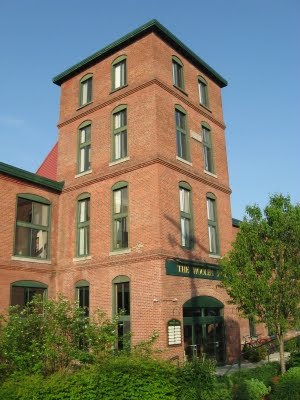
The old mill buildings really do look quite nice, I especially like this entrance to the Woolen Mill:


But I just think they would do better to be paired with new architecture more like these - both in Winooski, neither of them spectacular, but kind of interesting and reasonably handsome:


Sunday, April 24, 2011

By the water

Last Friday was Earth Day, Lenin's 140th birthday, my 38th birthday and, this year, Good Friday. The April 22nd I was actually born on (1973) was Easter Sunday.

Friday morning we were at a small beach town in Delaware, the last stop of a short vacation we took for the kids' spring break, cheap because it was the off season. I got up to run in the morning, it was in the low 40s and the boardwalk was nearly deserted. A sheet cloud covered the Eastern horizon far out over the Atlantic ocean, but as it approached the shore it gave way to small puffy clouds, close together like cobblestones. It was one of those rare moments when you can't see the sun, but its rays are visible shining down through cracks in the clouds, like the illustrations of God's love or holiness in those 14th or 17th century European paintings that so confused me in art museums when I was a little kid, befuddled by why anyone would want to paint so many pictures of a naked guy being tortured.

* * *

We drove back by way of scenic Route 9 along the Delaware coast, the "Coastal Heritage Greenway." The road is at places so close to sea level that there are numerous sign proclaiming that the road ahead is underwater if the lights are flashing, and so forth. Some of the land is farmland, some of it muddy tidal wetlands, a good portion of the latter protected as wildlife refuges.

At one point we drove a couple miles from Route 9 out to the actual shore, and stopped at what I'm guessing was once a fishing village, and is now a tiny pocket of poverty with a few people who try to make a living fishing. It had about two dozen small houses, a parking lot, boat ramp and a small pier which is closed from dawn to dusk unless you're fishing, and this ramshackle and abandoned structure:


Along with island nations and low-lying, densely populated areas like Bangladesh, this area of Delaware is almost certain to be covered by the ocean within a few decades. Unlike Bangladesh, it's not densely populated; the relative handful of I imagine mostly poor folks who eke out a living from the land and sea will be displaced into the rest of what passes for American society.

* * *

At that fishing village, we also got our first glimpse of the Salem Nuclear Power Plant, which sits on an artificial island between Delaware and New Jersey. It dominated our view all the rest of the way along the "Scenic Route," which oddly enough begins at an Air Force base and ends at an oil refinery.

Sunday, October 10, 2010

Homemade crackers with the kids


What with a looming danger of a full-time job in my immediate future, soon enough I probably won't be home in the afternoons with the kids. Not that I'm ever going to be as good a parent as the Sweet Juniper guy — I find it far too easy to ignore them now that they will occupy themselves reading or making WWII diaramas out of Lego or whatever it is they do upstairs — but I've been trying to plan at least one activity to do together with the kids each afternoon.

In practice, this has meant figuring out something to do with the boy, since the girl, now in middle school, has been playing middle-school soccer — meaning most weekdays we don't see her from 7:15 in the morning when she leaves home to catch the bus, until 5:30 at night when she gets home from soccer practice.

The boy really likes crackers, and I really like cooking, so a few weeks ago I enticed him into making crackers with me in part by showing him this video of Mark Bittman talking about and making crackers. So we made the Parmesan Cream Crackers (recipe here) and promptly ate them up. This afternoon, we repeated this with his sister helping out as well.


Here are the crackers after they were made (well, what was left of them after the kids & spouse had afternoon snack...):